
Hongkongers may soon pay for single-use plastic bags in stores
HONG KONG —
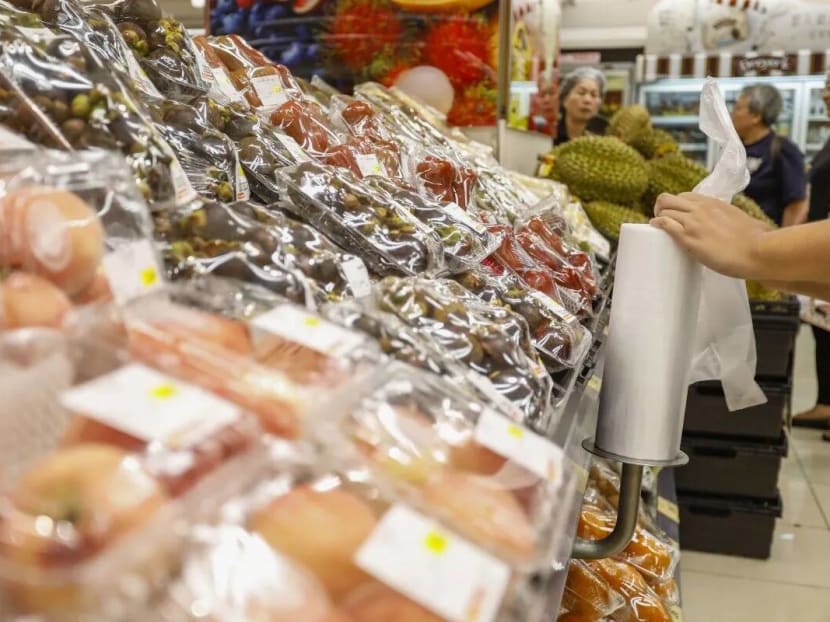
Government will engage Hong Kong’s supermarkets, which have often been criticised by green groups for using too much plastic wrapping.

HONG KONG — The Hong Kong government may charge consumers for using polythene bags to carry frozen goods and fresh bakery items, the environment minister has said, while outlining his strategy to tackle the city’s mounting plastic waste problem.
Plastic packaging at supermarkets will be reduced, while the use of microbeads in cosmetic products will be eliminated altogether as part of a plan to engage with Hong Kong’s major retailers and businesses, Secretary for the Environment Wong Kam-sing said in an interview with the Post.
“We will take a comprehensive approach and look at tightening regulations on plastic bags when buying cold or frozen meat, for example. At the moment, it is exempted no matter how many bags you take, but is it necessary?” Mr Wong said.
Under the existing regulations, “flat-top” bags without handles can be given for free if they are used to maintain food hygiene, or packaging unwrapped fresh produce and frozen or cold items.
Mr Wong said the plastic bag levy – which is currently HK$0.5 (S$0.09) – would be reviewed as part of an Environment Bureau review next year, which would take into consideration “complicated economic conditions”.
“People shouldn’t be worried about the increased charges, they can just bring their own bags,” he said.
The number of plastic bags sent to the city’s landfills each year has almost halved from 8 billion before 2009 to 4.4 billion in 2017. The plastic shopping bag charging scheme came into effect in 2009. However, the figure was lower in 2015, when 3.93 billion bags were sent to landfill.
Mr Wong said plastic waste reduction was also a part of the city’s commitment to addressing climate change. “Everything is linked to carbon footprint and climate change. Changes are necessary in every sphere, from Hong Kong’s fuel mix to transport and waste reduction.”
Mr Wong said the government would engage the city’s supermarkets – which had often been accused of using too much plastic wrapping by green groups – and small retailers, to reduce the use of polythene and offer alternative containers to customers.
Environmental NGO Greenpeace had earlier brought into attention a few glaring examples of plastic overuse. In one instance, the NGO found mangoes were encased in so much plastic wrap that unpacking one fruit was akin to peeling off multiple layers of onion skin. The NGO had also found instances where plastic bottles of fruit juice came in another plastic bag, and hardy fruits such as pineapples and coconuts were unnecessarily covered in cling film.
A survey carried out by Greenpeace among Hongkongers in May this year also found 70 per cent of respondents preferred shopping in supermarkets that stripped off unnecessary and wasteful plastic wraps.
Mr Wong said personal care products containing microbeads – plastic particles less than 5mm in size that are commonly used as an exfoliant but do not degrade or dissolve in water – would be eliminated altogether from the city’s market with the voluntary cooperation of brands and retailers.
Microbeads are damaging to both the environment and human health, as they cannot be removed from the waterways and can thus contaminate the marine food chain, eventually ending up on dinner plates through fish and other seafood.
Some of the biggest international personal care product manufacturers – L’Oreal, Procter & Gamble and Johnson & Johnson – have phased out microbeads, while Italy and India have become the latest countries to ban this type of plastic from 2020.
France, Taiwan, and Britain, among others, banned the import and manufacture of personal care products and cosmetics laced with microbeads in 2018.
“We are happy to know about the government’s determination to review the plastic bag rules. We hope the new rules will come up soon,” said Ms Vicki Wong Pui-chi, senior public affairs officer for green group Greeners Action.
She said the group had observed that customers often took more “flat-top” bags than they actually needed. She hoped the review would not only be about a revised levy on the use of plastic bags, but also about a rule on the number of bags that could be exempted.
She said the government should ban the use of all types of plastic by 2030.
Ms Vicki Wong also said the use of plastic bags in restaurants was increased by 9.6 per cent between 2016 and 2017.
She urged the government to set a clear and time-bound action plan to phase out microbeads. “We hope the government will look into the use of every type of plastic and seriously consider the health of the people and the environment.” SOUTH CHINA MORNING POST
Related topics
plastic bags Hong Kong climate changeStay in the know. Anytime. Anywhere.

Subscribe to our newsletter for the top features, insights and must reads delivered straight to your inbox.
By clicking subscribe, I agree for my personal data to be used to send me TODAY newsletters, promotional offers and for research and analysis.






