
How durian became the coveted gift for girlfriends, future in-laws in China
GUANGDONG — In Ma Qian’s hometown in a rural county in central China’s Henan province, it is customary to send between four and six gifts to friends and relatives when they get engaged or married.
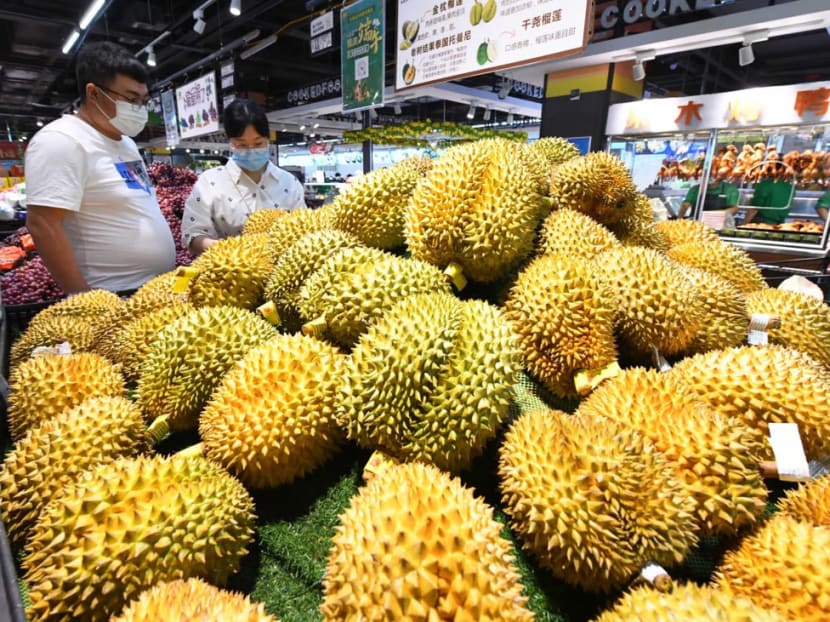
China’s durian import in the first quarter of 2023 soared by more than 150 per cent, according to Chinese customs data.

GUANGDONG — In Ma Qian’s hometown in a rural county in central China’s Henan province, it is customary to send between four and six gifts to friends and relatives when they get engaged or married.
The gifts usually consist of grapes, ham sausage, milk and dried mushrooms.
But now durian, a pungent tropical fruit from Southeast Asia that is enjoying growing popularity in China, has now become an option.
“My cousin got engaged last month and my mother-in-law asked me to replace the grapes with durian, as she thinks it is more decent and fashionable as a present,” said twenty-something Mr Ma, who runs a small painting workshop for children in Miyang.
“She and many locals had durian for the first time this year and quickly liked the taste. It’s funny that my mother-in-law, who is a typically frugal rural elderly person, now often hints to us to buy a durian to treat her.
“The old folks believe that durian is highly nutritious and that eating one durian is equal to eating three chickens.”
So-called cherry freedom — which means the ability to buy expensive fruit without a second thought — has long been a buzzword in China as a symbol of wealth and prosperity, and it is now becoming durian freedom.
Helped by lower taxes and streamlined customs procedures under the Regional Comprehensive Economic Partnership (RCEP) trade pact, which is mainly between China and the 10 members of the Association of Southeast Asian Nations, imports of durian and other tropical fruits have soared and entered more markets, including lower-tier cities.
“Durian is a hot commodity among small-town youngsters. At cafes, there are durian layer cakes and raw durian and coconut lattes,” added Mr Ma.
“We like to buy one durian a month to share with our family, sometimes 40 yuan (S$7.42) a kilo, sometimes 60 a kilo.
“Now, people like to talk about what makes a good durian, the thick stalk, the rounded shape and the short thorns. As for which country it originates from, we don’t seem to care much.”
Thailand, Malaysia, Vietnam and the Philippines — all RCEP members — are the main suppliers of durian to China.
Ambitious and optimistic Chinese investors are now rushing into the market, from contracting orchards in Vietnam and Thailand to building cold chain logistics services and e-commerce platforms.
Despite highly restrictive import controls as part of Beijing’s zero-Covid policy during the coronavirus pandemic, China imported around four times as many fresh durians in 2022 compared with 2017, bringing the total value to more than US$4b (S$5.3b).
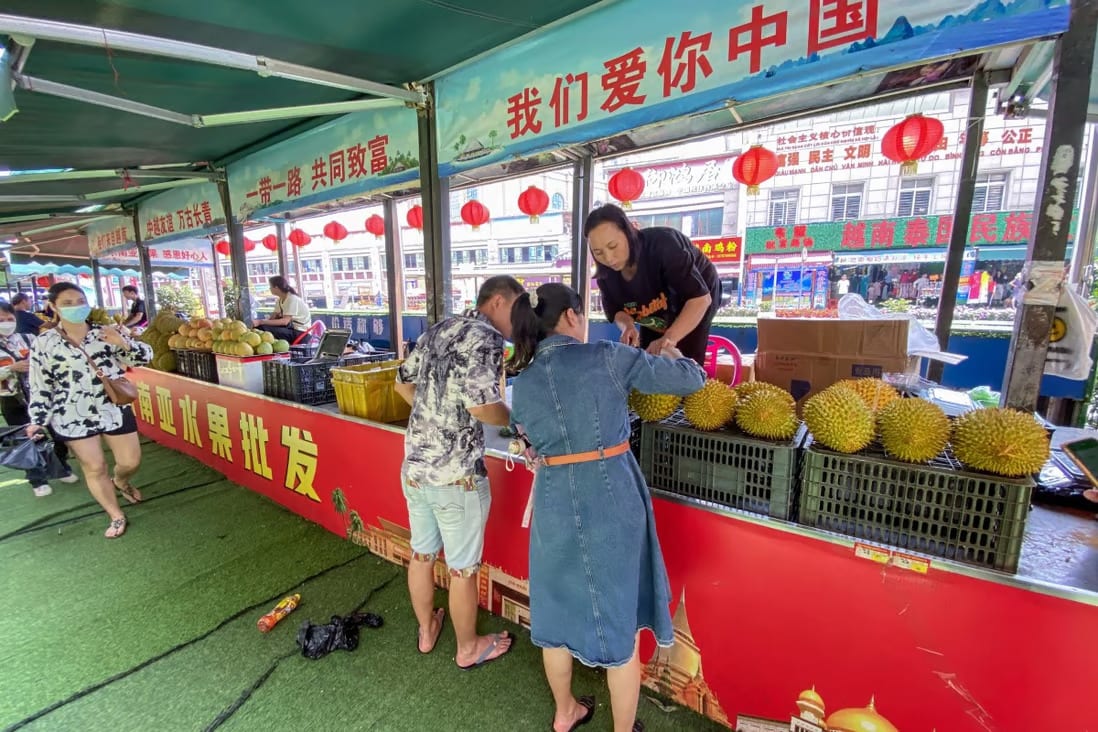
And its imports in the first quarter of 2023 soared by more than 150 per cent, according to Chinese customs data.
The average import price in the first quarter was 38.3 yuan per kg, a decrease of 4.2 per cent compared with the same period last year, the data showed.
From the start of April to mid-May, durian sales on Meituan — China’s leading food delivery platform — surged by 711 per cent compared to the same period in 2022, according to financial news site Yicai.
With the start of the peak season for durian shipments from Southeast Asia in May and June, retail prices in China have significantly decreased and become much more affordable to customers.
In wholesale markets across China, average prices range from 36 yuan to 52 yuan per kg, depending on specification and variety, according to merchants at Jiangnan wholesale fruit and vegetable market in Guangzhou — China’s largest fruit market.
Mr Zhang Liang, a truck driver in Jingzhou, a county-level city in central China, sent a durian that cost over 300 yuan to his wife as a birthday gift.
“Local bachelors used to go to their girlfriend’s home with grapes, peaches and white wine, but now they need a carton of durian, which will make future mothers-in-law feel special in the neighbourhood,” said Mr Zhang.
Easier and quicker access allows imported durian to reach all parts of China within three days, making it possible for the market to multiply, said importer Bob Wang.
He has contracted durian farms in Vietnam covering 3,000ha and plans to import more than 3,000 containers, or 60,000 tonnes of durian, this year.
“Durian has quickly become the most popular imported fruit in China, but we might still have underestimated the Chinese people’s appetite for it,” said Mr Wang, the founder of TWT Supply Chain, which has more than 3,000 self-owned and contracted truckers nationwide.
“According to the current enthusiasm, it is very likely that annual demand could double in the next few years.”
China is also trying to produce home-grown durian on the tropical island province of Hainan, but for some, the price is still too high.
“In our small county in remote northwest China, the average price is 35 yuan for 500g now, and it was 48 yuan during the [Lunar New Year], which should be the most expensive in the whole country,” said a user on Chinese Twitter-like online networking tool Weibo.
“If it is not for my girlfriend who likes to eat durian, I am really reluctant to spend the money.” SOUTH CHINA MORNING POST
Related topics
China durian RCEPStay in the know. Anytime. Anywhere.

Subscribe to our newsletter for the top features, insights and must reads delivered straight to your inbox.
By clicking subscribe, I agree for my personal data to be used to send me TODAY newsletters, promotional offers and for research and analysis.






