
How fake Mark Zuckerbergs scam Facebook users out of their cash
SAN FRANCISCO — A Facebook notification on Mr Gary Bernhardt’s phone woke him up one night in November with incredible news: a message from Mr Mark Zuckerberg himself, saying that he had won US$750,000 (S$996,000) in the Facebook lottery.
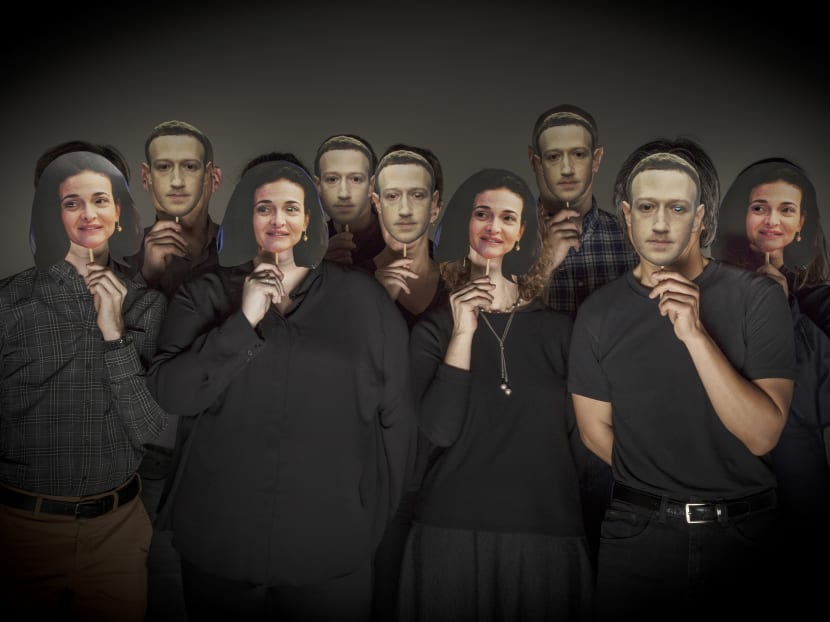
Models in a photo studio pose with masks depicting Facebook executives Mark Zuckerberg and Cheryl Sandberg in New York.

SAN FRANCISCO — A Facebook notification on Mr Gary Bernhardt’s phone woke him up one night in November with incredible news: a message from Mr Mark Zuckerberg himself, saying that he had won US$750,000 (S$996,000) in the Facebook lottery.
“I got all excited. Wouldn’t you?” said Mr Bernhardt, 67, a retired forklift driver and Army veteran in Ham Lake, Minnesota. He stayed up until dawn trading messages with the person on the other end. To obtain his winnings, he was told, he first needed to send US$200 in iTunes gift cards.
Hours later, Mr Bernhardt bought the gift cards at a gas station and sent the redemption codes to the account that said it was Mr Zuckerberg. But the requests for money didn’t stop. By January, Mr Bernhardt had wired an additional US$1,310 in cash, or about a third of his Social Security checks over three months.
Mr Bernhardt eventually realised that he had been the unwitting victim of a scam that has thrived on Facebook and Instagram by using the sites’ own brands — and its top executives — to lure people in.
At a time when the real Zuckerberg has vowed to clean up Facebook, the Silicon Valley company has failed to eliminate impostor accounts masquerading as him and his chief operating officer, Ms Sheryl Sandberg, to swindle Facebook users out of thousands of dollars.
An examination by The New York Times found 205 accounts impersonating Mr Zuckerberg and Ms Sandberg on Facebook and its photo-sharing site Instagram, not including fan pages or satire accounts, which are permitted under the company’s rules.
At least 51 of the impostor accounts, including 43 on Instagram, were lottery scams like the one that fooled Mr Bernhardt.
The fake Zuckerbergs and faux Sandbergs have proliferated on Facebook and Instagram, despite the presence of Facebook groups that track the scams and complaints about the trick dating to at least 2010.
A day after The Times informed Facebook of its findings, the company removed all 96 impostor Mark Zuckerberg and Sheryl Sandberg accounts on its Facebook site. It had left up all but one of the 109 fakes on Instagram, but removed them after this article was published.
“Thank you so much for reporting this,” said Mr Pete Voss, a Facebook spokesman. He could not say why Facebook had not spotted the accounts posing as its top executives, including several that appeared to have existed for more than eight years. “It’s not easy,” he said. “We want to get better.”
Facebook requires people to use their authentic name and identity. Yet the company has estimated that perhaps 3 per cent of its users — as many as 60 million accounts — are fake. Some of those accounts are disguised as ordinary people, some pretend to be celebrities such as Justin Bieber.
In congressional testimony this month, Mr Zuckerberg said Facebook was improving its software to automatically detect and remove such accounts. Facebook officials have said the company blocks millions of fake accounts trying to register each day and analysts said the social network has improved its efforts to remove the accounts.
“Fake accounts, overall, are a big issue, because that’s how a lot of the other issues that we see around fake news and foreign election interference are happening as well,” Mr Zuckerberg told lawmakers, adding that Facebook is hiring more people to work on reviewing content.
But major holes remain. Interviews with a half-dozen recent victims — and online conversations with nine impostor accounts — showed that the Facebook lottery deception is alive and well, preying particularly on older, less educated and low-income people.
The Mark Zuckerberg and Sheryl Sandberg impostor accounts typically use the executives’ pictures as profile photos and list their Facebook titles. Some post manipulated images of people holding oversize checks. The names of Mr Zuckerberg and Ms Sandberg are sometimes misspelled, or use parentheses and middle names (Elliot for Zuckerberg and Kara for Sandberg) to evade Facebook’s software.
Many of the impersonators had dozens to hundreds of followers; several had thousands. They are aided by a network of other sham accounts with generic names, such as Jim Towey and Mary Gilbert, which purported to be “Facebook claim agents.”
The scammers seek victims who, based on their Facebook and Instagram profiles, seem vulnerable, said Mr Robin Alexander van der Kieft, who manages several Facebook groups that track the scams. The various fake accounts share information about successful shakedowns and continue pouncing on those victims, he said.
He has traced many of the Internet Protocol addresses of these fake accounts to Nigeria and Ghana.
The pitch often begins with an unsolicited “Hello. How are you doing?” on Facebook or Instagram. The fake accounts then proceed, sometimes in broken English, to inform people of their enormous Facebook lottery prize.
After several messages between The Times and a fake Sheryl Sandberg account on Instagram last week, the impostor offered US$950,000 and a new car via the “Facebook splash promotion 2018.”
When asked for proof the account was Sandberg, the scammer sent a Photoshopped identification. “I want you to know that this Promo is 100% Real and Legitimate and the Government are aware of this Promo you don’t have to be skeptical all you just have to do is to follow all instruction giving to you okay,” the account added.
Three days later, the account said it needed a US$100 iTunes gift card to process and activate the winning ATM card. (iTunes gift cards can quickly be redeemed and traded on the black market for cash.)
After initially resisting, the sham Sandberg agreed to a phone call, adding “I’m not the one that will be speaking to you OK.” Seconds later, a call arrived from a number with a 650 area code — Silicon Valley.
“You have to be careful, there are lots of scam artists,” a man said in accented English after he was informed that he was speaking with The Times. He added, “All I’m trying to do is get your winning package.”
The Times reached out to more than 50 impostor accounts. Most messages went unreturned. None that replied broke character.
The charade has ensnared people like Ms Donna Keithley, 50, a stay-at-home mom with four children in Martinsburg, Pennsylvania. In March 2016, an account with the name Linda Ritchey messaged Ms Keithley “on behalf of the Facebook CEO Mark Zuckerberg” to pass on word of her good fortune: US$650,000 in lottery winnings. Ms Keithley wired US$350 — a delivery fee — the next day.
That began a month-long saga. According to a 28,000-word transcript of a Facebook Messenger conversation between Ms Keithley and the account, the scammer repeatedly played on Ms Keithley’s Christian faith to get her to send more money.
“Are you good Christian with god fears?” the Linda Ritchey account asked. “Can you trust me and also have believe in me?”
Over the next month, Ms Keithley received not only Facebook messages but a call from a Zuckerberg impostor who assured her the lottery was real. She even heard from a Facebook account masquerading as Ms Eileen M. Decker, the former US attorney in Los Angeles, asking for US$205 to process her winnings.
The Times found at least five Facebook accounts posing as Ms Decker and advertising government grants, another known scam.
Ms Decker told The Times that she has tried to get Facebook to remove the accounts, but the site wanted a picture of her government-issued identification to do so. She refused. “To me, they’re not a trusted source,” she said. She added that she had contacted the FBI and hired a lawyer.
Ms Keithley’s scammer ordered her to open new credit cards and bank accounts, and even to get a loan using her husband’s 2001 Ford Taurus as collateral. Midway through the month, she said she had a minor stroke from the stress.
By April 2016, she had used her family’s tax refund and loans from relatives to pay the scammer US$5,306.43 — much of it in money transfers to the name Ben Amos in Lagos, Nigeria.
“It just devastated the whole household,” said her husband, Mr Tim Keithley, a security guard who was making US$10 an hour at the time.
The ordeal was so costly, Ms Donna Keithley said, the family’s telephone service was shut off. They also had to go to a food bank.
While Ms Keithley still gets messages from accounts claiming to work for Facebook, she said she is now wiser. “Lord as my witness, no one’s getting any more money from me,” she said. THE NEW YORK TIMES
Stay in the know. Anytime. Anywhere.

Subscribe to our newsletter for the top features, insights and must reads delivered straight to your inbox.
By clicking subscribe, I agree for my personal data to be used to send me TODAY newsletters, promotional offers and for research and analysis.






