
Indonesia starts count to solve the riddle of the islands
JAKARTA — Indonesia stretches more than 5,000 kilometres from the Indian Ocean to the South Pacific. But the world’s largest archipelago nation does not know how many islands it has. So as competition for resources and territorial control heats up in Asian waters, the government has renewed a drive to count the islands definitively and register their names with the United Nations.
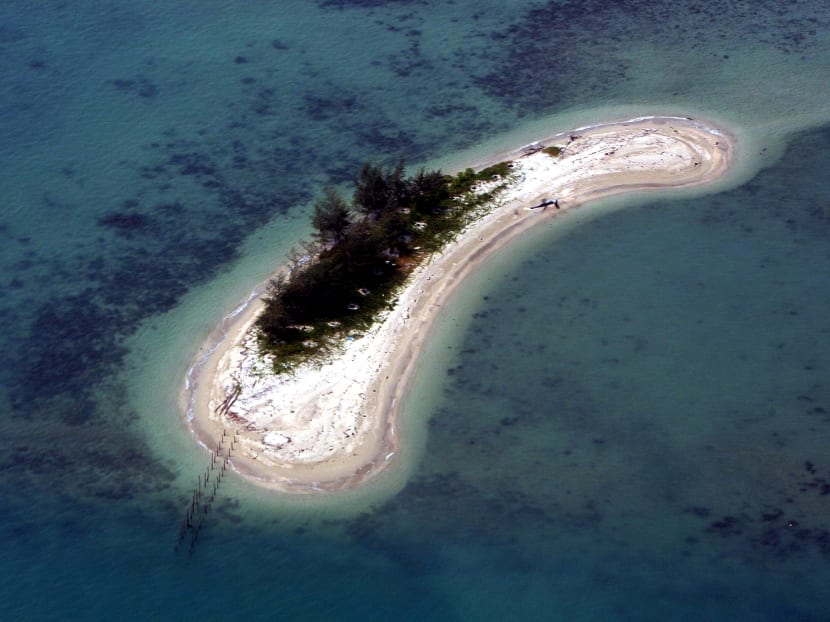
An aerial view of an unnamed Indonesian island in Riau province October 6, 2007. Photo: Reuters

JAKARTA — Indonesia stretches more than 5,000 kilometres from the Indian Ocean to the South Pacific. But the world’s largest archipelago nation does not know how many islands it has. So as competition for resources and territorial control heats up in Asian waters, the government has renewed a drive to count the islands definitively and register their names with the United Nations.
“It’s not so easy,” says Mr Brahmantya Satyamurti Poerwadi, who heads the spatial management department at the Ministry of Marine Affairs and Fisheries. “It can take up to six days to get to some of these faraway islands and then many people disagree on the name. Traditionally, it might have been called X but the people who live there call it Y and the nearby fishermen call it Z.”
Indonesian diplomats were instrumental in creating the legal concept of an “archipelagic state” within the UN Convention on the Law on the Sea, which was signed in 1982. Archipelagic states have sovereignty over all the waters contained within their outer limits, not just the land masses. But the question of how many islands there are has long been a vexed issue in a nation of hundreds of ethnicities, tribes and languages, whose boundaries were set by the arbitrary limits of Dutch colonial expansion.
A 1996 law states that there are 17,508 islands but that is an estimate rather than the result of a definitive survey, which is a tough exercise in a sprawling nation blighted by poor infrastructure and weak governance.
“The 17,000 islands figure is a source of pride and concern at the same time,” says Mr Evan Laksmana, a researcher at the Centre for Strategic and International Studies (CSIS), a Jakarta think-tank. “It highlights our diversity but also the challenges of separatism, security and decentralisation.”
Indonesia has since passed two islands to Malaysia and two to Timor-Leste, which secured independence from Indonesia in 2002. Others have disappeared or emerged because of environmental change and seismic activity. As of the last UN Conference on the Standardisation of Geographical Names in 2012, the government had formally counted and registered only 13,466 islands.
Mr Poerwadi and colleagues from the Indonesian navy and other departments have since recorded 1,700 more and plan to register them at the next five-yearly UN conference this August. He spends his days travelling to some of the world’s most remote and untouched tropical islands, a far cry from his previous life as a computer programmer living in the humdrum London suburb of South Woodford.
“I didn’t like London,” he says in his Jakarta office. “It’s too gloomy.” In the past couple of weeks he has journeyed from Weh, Indonesia’s westernmost island, to Biak in Papua, 4,500km to the east — farther than the distance from New York to Los Angeles.
His favourite islands are “the ones where I can’t be contacted by phone”, he jokes, putting him beyond the reach of his boss Ms Susi Pudjiastuti, Indonesia’s irascible and wildly popular minister of marine affairs. The drive to record the remaining islands has been given new impetus by President Joko Widodo, who came to power in 2014. He promised to reinvigorate Indonesia’s maritime economy and uphold sovereignty at a time when Chinese assertiveness has intensified regional territorial disputes.
While registering the names with the UN does not equate to a legal claim of sovereignty, Mr Poerwadi says it helps mark Indonesia’s territory. Moreover, he says he is helping to uphold Indonesian sovereignty by supporting fishermen on outlying islands in places such as the Natuna Sea, where China argues it has “overlapping claims for maritime rights and interests”.
Mr Laksmana of CSIS says that because Indonesia lacks the naval and coast guard capacity to monitor its extensive waters, one solution is “to help our own fishermen harvest the resources”.
Mr Poerwadi, a chirpy character with an encyclopedic knowledge of the outlying islands, says he is driven by a desire to improve the livelihoods of remote communities. Several months ago, the owner of small island near Sulawesi tried to sell it to Mr Poerwadi after her husband racked up debts fighting a failed local election campaign. “She only wanted Rp4 billion (S$416,589) for 40 hectares, which was quite cheap,” he says.
“But it’s better if her family continues to live there, so I gave her some help with aquaculture instead.”
As he downs a shot of sopi, a throat-burning spirit he acquired on a recent trip to the Tanimbar Islands in south-east Maluku, he talks of the responsibility he feels.
Less than 500km from Darwin in north Australia, the Tanimbar residents live in extremely basic conditions, with limited sources of fresh water, little education or entertainment and few connections to the outside world. “I recently saw some kids there playing with a sea turtle, which they’d tied with a long rope and kept pulling back,” he says.
“I told them to release it and gave them some soccer balls to play with instead. They don’t even have proper toys there. Somebody needs to take care of these people.” FINANCIAL TIMES
Stay in the know. Anytime. Anywhere.

Subscribe to our newsletter for the top features, insights and must reads delivered straight to your inbox.
By clicking subscribe, I agree for my personal data to be used to send me TODAY newsletters, promotional offers and for research and analysis.






