
Israeli rejection of two-state solution 'unacceptable': UN chief
UNITED NATIONS — Israel's rejection of the idea of a two-state solution with the Palestinians is unacceptable and could prolong the war in Gaza, United Nations Secretary General Antonio Guterres said on Tuesday (Jan 23).
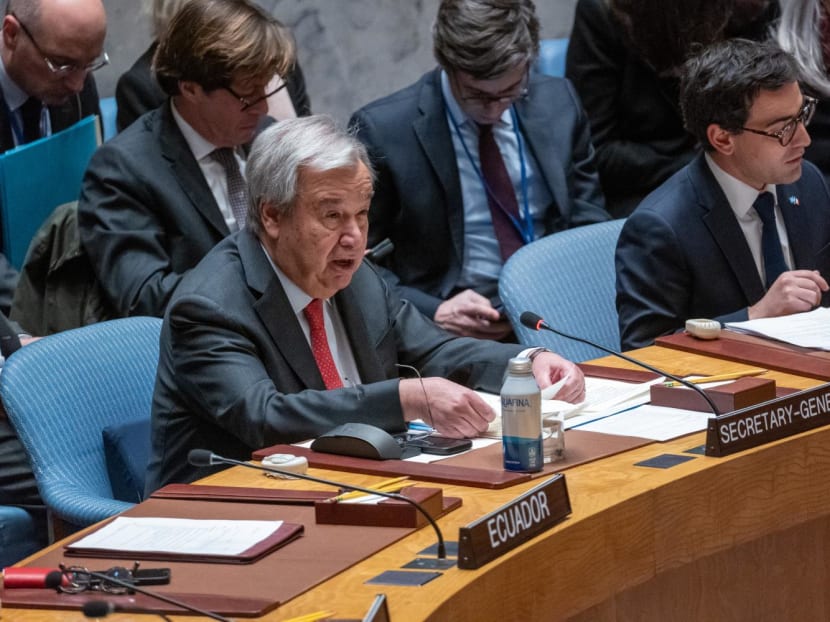
United Nations (UN) secretary-general Antonio Guterres speaks at a UN Security Council meeting on the Middle East, including the situation in Gaza and Israel, on Jan 23, 2024 in New York City.


This audio is AI-generated.
UNITED NATIONS — Israel's rejection of the idea of a two-state solution with the Palestinians is unacceptable and could prolong the war in Gaza, United Nations Secretary General Antonio Guterres said on Tuesday (Jan 23).
"Last week's clear and repeated rejection of the two-state solution at the highest levels of the Israeli government is unacceptable," Mr Guterres said in a speech to the Security Council.
"This refusal, and the denial of the right to statehood to the Palestinian people, would indefinitely prolong a conflict that has become a major threat to global peace and security," Mr Guterres told the meeting.
Such an outcome "would exacerbate polarisation and embolden extremists everywhere," he added.
Mr Guterres called for the universal recognition of the "right of the Palestinian people to build their own fully independent state."
Israeli Prime Minister Benjamin Netanyahu has drawn global condemnation in recent days — and defied the United States, which provides Israel with billions of dollars in military aid — by rejecting calls for a Palestinian state.
That rejection has come as Israel pounds Hamas in Gaza, where the death toll reached nearly 25,500 on Tuesday, with around 70 per cent of the dead women and children, according to the territory's health ministry.
The offensive began in response to the unprecedented attack by Hamas fighters on Oct 7 that resulted in the deaths of about 1,140 people, mostly civilians, according to an AFP tally based on official Israeli figures.
The militant group also seized about 250 hostages during the attack, with around 132 still remaining in Gaza.
ISRAEL AT ODDS WITH ALLIES
Mr Netanyahu's office last week said Israel "must retain security control over Gaza," even after "Hamas is destroyed," days after the prime minister had also rejected Palestinian sovereignty over the occupied West Bank.
He proclaimed Israel's need to have "security control over all the territory west of the (River) Jordan."
Israel's allies have criticised its comments, though few seem prepared to seriously walk back support.
"We must have a Palestinian state," said French Foreign Minister Stephane Sejourne, chairing Tuesday's Security Council meeting.
And even as Netanyahu told United States (US) President Joe Biden directly that he rejects Palestinian sovereignty in the Gaza Strip, Washington has maintained that it can still work with Israel on the issue.
"It's President Biden's firm conviction that two states, with Israeli security guaranteed, are the only path to durable peace," US undersecretary for human rights Uzra Zeya said on Tuesday.
Calling for a ceasefire, Palestinian Authority Foreign Minister Riyad Al Maliki said the "disregard for Palestinian life" should no longer be tolerated, while Russian top diplomat Sergey Lavrov said the United States has blocked "all efforts and initiatives geared towards ending the bloodshed."
Israeli Ambassador Gilad Erdan said while "it is important" to provide aid to Gaza, Iran is "the root of the dire threat to the Middle East and the world."
Mr Guterres demanded that "Israel's occupation must end."
"The entire population of Gaza is enduring destruction at a scale and speed without parallel in recent history," he said, also calling for the establishment of new humanitarian crossing points and the resumption of aid operations at the Israel port of Ashdod.
International organisations have warned that after three and a half months of relentless airstrikes and a ground invasion, the tiny land strip's two million occupants face an acute humanitarian crisis, including the threat of famine and disease. AFP
Related topics
United Nations Israel PalestineStay in the know. Anytime. Anywhere.

Subscribe to our newsletter for the top features, insights and must reads delivered straight to your inbox.
By clicking subscribe, I agree for my personal data to be used to send me TODAY newsletters, promotional offers and for research and analysis.





