
Kelantan folk say bid to revive cultural heritage is 26 years too late
KUALA LUMPUR — Every evening after Isyak prayers, Mr Azwan Abdullah will head to a coffee shop on the edge of the Kok Majid jetty in Tumpat, Kelantan, to play chequers with friends.
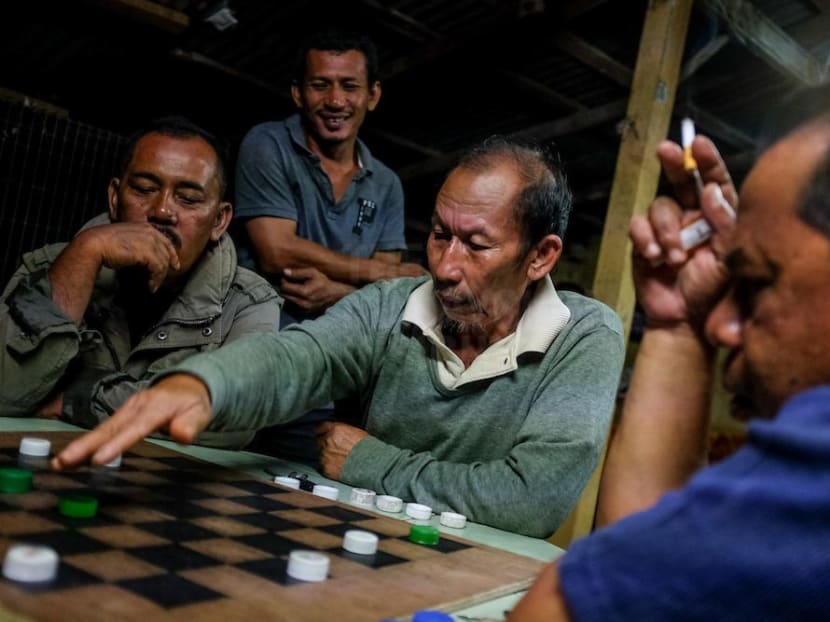
Kampung Kok Majid villagers playing chequers after Isyak prayers. This is one of the few entertainment activities not banned by the Kelantan state government.

KUALA LUMPUR — Every evening after Isyak prayers, Mr Azwan Abdullah will head to a coffee shop on the edge of the Kok Majid jetty in Tumpat, Kelantan, to play chequers with friends.
For Mr Azwan and his friends living in Kampung Kok Majid, 15km from Kota Baru, chequers is one of the activities available for their entertainment, and one of few not banned by the Parti Islam Se-Malaysia (PAS) ruled state on grounds of protecting Islam.
“This is our entertainment when we get back in the evening after work and we continue after Isyak. Even the tok bilal (muezzin) would join us,” he told The Malaysian Insight.
Two years after PAS took over the Kelantan government in 1990, it started to “restructure” the arts, cultural and entertainment activities, including traditional performances, such as mak yong, menora, wayang kulit and dikir barat, so that they do not go against Islamic principles.
The state then imposed a ban on these activities through the Entertainment Control and Entertainment Places Enactment 1998 which listed mak yong as prohibited entertainment along with menora, wayang kulit, main puteri, Thai boxing and animal fighting.
United Nations representative Karima Bennoune, when visiting Malaysia last year, called on the Kelantan government to withdraw the ban on public performances and other traditional Malay art forms.
Local arts must be celebrated and appreciated as one of the oldest performing arts in the world, the UN Special Rapporteur on cultural rights has said.
For Mr Azwan, 42, the ban led to the gradual drifting away of legacies and their cultural heritage.
He said the state government’s efforts to promote its cultural heritage is too late as the art forms are extinct.
“I used to see wayang kulit and mak yong but now it’s hard to enjoy them anywhere in the state. You can say there isn’t any more,” he said.
Mr Azwan was a dikir barat champion and had even produced a dikir barat album.
(Dikir barat involves 15 or more people doing responsorial singing, led by a couple of lead singers and accompanied by Malay percussions).
After 26 years of banning these activities for being un-Islamic, the PAS government is now trying to revive traditional cultural arts among them by creating a heritage village in Kg Laut in Tumpat.
“This place will be a tourist attraction. The new state government wants to revive the old culture of Kelantan," said Mr Azwan.
“The Kampung Laut Mosque will also be brought back here,” he said, referring to the 18th-century wooden mosque transferred to the neighbouring district of Nilam Puri after the 1966 floods.
In addition to bringing the mosque back to its original village, the heritage village will revive the performing arts and Kelantan specialty food like serunding (meat floss) and dodol (sweet toffee-like sugar palm-based confection).
The state government project with the cooperation of the East Coast Economic Region Development Council (ECERDC) is expected to cost RM30 million (S$9.86 million), including compensation for land acquisition.
Mr Azwan, however, does not believe that the PAS government would be able to revive the traditional arts, such as mak yong, wayang kulit and main puteri plays, because the performers are almost extinct and the new generation does not recognise these activities.
“Many people joke that if and when the Kelantanese want to see these plays, they go to Kuala Lumpur. Here, there is nothing… hard to find, old performers are not here.”
But not everyone feels like Mr Azwan, especially those who feel that such artistic and cultural activities are useless and “cause people to forget religion”.
A resident who wished to be known as Mr Mahmud, 77, said mosques and surau would be empty if mak yong, wayang kulit and dikir barat are allowed back without the state’s strict supervision.
“I like to see martial arts and wayang kulit but I have not been waiting for the Isyak prayers to go to (surau) to see the wayang kulit. We do not want to a situation where you watch these activities until late night and miss your dawn prayers.
“Islam cannot be allowed to decline. Culture can be allowed to be regressive, as there is nothing about it in the hadith or the Quran.
“We have to protect our religion. Islam belongs to Allah, we cannot let it decline. Priority must be given to our religion. Culture can be adapted accordingly,” he said. THE MALAYSIAN INSIGHT
Stay in the know. Anytime. Anywhere.

Subscribe to our newsletter for the top features, insights and must reads delivered straight to your inbox.
By clicking subscribe, I agree for my personal data to be used to send me TODAY newsletters, promotional offers and for research and analysis.






