
A factory worker at 13, HK's iconic billionaire Li Ka-shing retires
HONG KONG — Mr Li Ka-shing, a wartime refugee who used to sweep factory floors in Hong Kong for a living, announced his retirement on Friday (March 16) after a career spanning more than half a century amassing one of Asia’s biggest fortunes from building skyscrapers to selling soap bars.
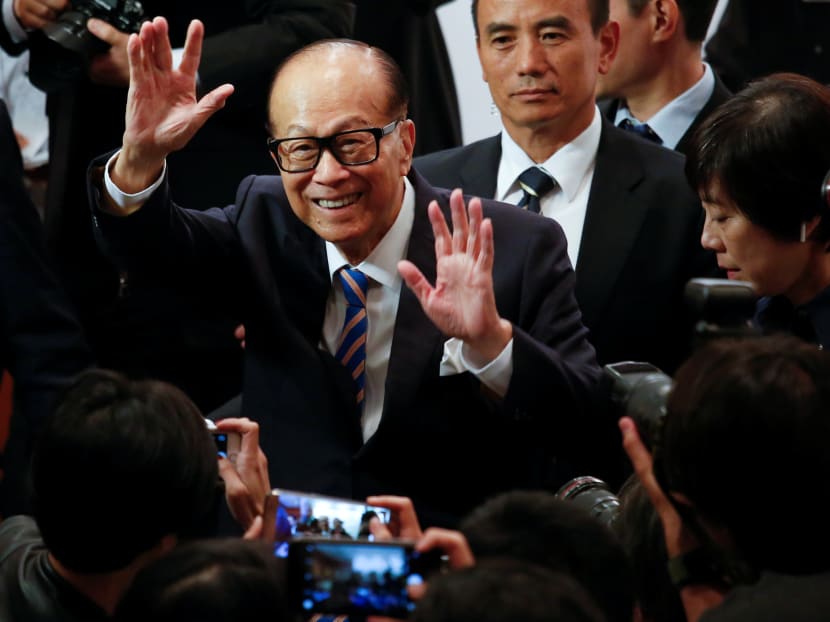
Hong Kong tycoon Li Ka-shing waves goodbye after announcing his retirement as the chairman of CK Hutchison Holdings Ltd. Photo: Reuters

HONG KONG — Mr Li Ka-shing, a wartime refugee who used to sweep factory floors in Hong Kong for a living, announced his retirement on Friday (March 16) after a career spanning more than half a century amassing one of Asia’s biggest fortunes from building skyscrapers to selling soap bars.
The 89-year-old chairman of CK Hutchison Holdings Ltd and CK Asset Holdings Ltd will stay an adviser to the group after stepping down in May.
Elder son Victor, 53, will take over a conglomerate that touches the lives of practically everyone in Hong Kong — the family’s Power Assets Holdings Ltd generates their electricity and ParknShop supermarkets sell their groceries.
The group also operates mobile-phone stores and Superdrug and Savers in the United Kingdom, owns ports around the world and a controlling stake in Husky Energy Inc in Canada.
“Looking back all these years, it’s my honour to have founded Cheung Kong and to have served society,” Mr Li told a packed room of journalists in Hong Kong. It’s been “my greatest honour,” he said.
The retirement came on a high note as Mr Li’s four biggest companies —CK Hutchison, CK Asset, CK Infrastructure Holdings Ltd. and Power Assets Holdings Ltd. — reported higher 2017 profits.
All four stocks rose, through the announcement — including two of the earnings — came after the end of trading in Hong Kong.
With a fortune of about US$34 billion (S$44.63 billion), according to the Bloomberg Billionaires Index, Mr Li has been a fixture as the city’s richest man for an entire generation of Hong Kongers and spearheaded an era defined by a handful of swashbuckling Chinese immigrants who built large empires across Asia.
For many, he is the face of the changing fortunes of Hong Kong as the former colony’s British elite gave way to Chinese dynasties.
“Li’s retirement symbolises the end of an era,” said Professor Joseph P H Fan at the Chinese University of Hong Kong, who has researched family-run businesses for two decades.
“No one can replace Li Ka-shing as the legendary founder of the largest conglomerate in Hong Kong.”
His retirement announcement illustrates his confidence over business continuity, given that he has prepared his son for several decades, Prof Fan said.
UBER-CAPITALIST
Mr Li personifies some of the conflicts that came from the region’s rise: Dubbed “Superman” by local media for his business acumen, he symbolises inequality in a city with one of the most lopsided wealth demographics on the planet.
He is a property developer who has won admiration for his entrepreneurial skills and a manager with companies so dominant that they often stifle smaller competition.
He also is an uber-capitalist who courted communist leaders.
A major figure in China’s emergence as an economic superpower, Mr Li is the most prominent among a generation of Hong Kong tycoons who charged across the border after Deng Xiaoping and his successors promoted economic reforms. His investments in the mainland span across industries ranging from energy to retail and infrastructure.
Starting with some well-timed local property investments that cemented his wealth, Mr Li built a business empire that included retail, energy, ports, telecommunications, media and biotechnology companies worldwide.
Overseas, Li-controlled companies are among the biggest foreign investors in the UK.
For many in Hong Kong, Mr Li is a dealmaker and investment guru on par with the likes of Mr Warren Buffett.
"Li Ka-shing's real genius, to me, is not necessarily in the assets he acquired, but his ability to sell them at the right time," said Mr Jonathan Galligan, head of Asia gaming and conglomerates research at CLSA, the brokerage. "Look at anything he sold and, plus or minus a year, its hard to say he didn't pick the top - that's a tremendous skill."
One of Mr Li's best-known deals in this respect was the 1999 sale of its UK telecoms unit, Orange, to Germany's Mannesmann at the height of a market boom. After Vodafone bought Mannesmann soon after, the subsequent forced disposal of Orange to France Telecom produced a second windfall for the Li empire, which netted US$21 billion in profits from the two deals.
Mr Li is also a major investor in technology startups such as Facebook, Spotify and Siri. During public appearance, he’d routinely be asked for prognostications on stocks, the real estate market and the economy.
Even toward the end of his career, he didn’t slow down his dealmaking.
In 2015, the mogul restructured his major holdings into two companies, one housing his property assets and the other holding the rest.
He followed with the A$7.4 billion (S$7.56 billion) takeover of Australian power provider Duet Group in 2017.
RAGS TO RICHES
Shrouded in myth and filled with apocryphal anecdotes and tales of family misfortune, Mr Li's name has become synonymous with against-the-odds success by dint of hard work.
He was born July 29, 1928 in Chaozhou, a city in southern China’s Guangdong Province.
His father was a school principal but the young Mr Li’s formal education stopped at high school as invading Japanese troops reached Guangdong.
Fleeing war-torn China for Hong Kong in 1940, Mr Li found work as an apprentice in a watch strap factory at the age of 13, while also caring for his ailing father, who soon died from tuberculosis.
By 19, he had become general manager of the factory, overseeing up to 300 workers and office staff.
After the war, Mr Li made his first fortune as a manufacturer of plastic flowers. His career as property mogul began in the late 1950s when, unable to renew his lease, he bought the site of his factory.
In the years to come, Li invested in local real estate as others sold, most notably in 1967, when riots inspired by Mao Zedong’s Cultural Revolution in China rocked Hong Kong and sent property prices plunging.
His most symbolic coup as a businessman may have come in 1979, when he bought control of trading house Hutchison Whampoa from Hongkong and Shanghai Banking Corp.
Mr Li quietly negotiated with the bank, now called HSBC Holdings Plc, to buy Hutchison shares for less than half their book value.
HSBC agreed and Mr Li became the first person of Chinese origin to own one of the British-founded companies that had dominated the local economy since the colony’s founding in 1841.
That reputation helped Mr Li make inroads in China, where he mixed extensive political connections with financial interests.
Mr Li was a senior adviser to the Chinese government on Britain’s 1997 handover of Hong Kong and served on the committee that drafted the Basic Law, the city’s mini-constitution under Chinese rule.
But despite the fables of Mr Li's thrift and being an active philanthropist, many Hong Kongers resent the pervasive role his family plays in the local economy.
They also blame the oligopolistic dominance of tycoons such as Mr Li for social ills including a gaping wealth gap, extensive harbour reclamation, heritage demolition and extortionate property prices.
It is true that it would be difficult to spend a day in Hong Kong without enriching the Li empire and Hong Kongers sometimes use a Cantonese pun on his name, which translates to "Li family city".
16-HOUR WORKDAY
However, close Chinese ties had their downside too, particularly in the United States, as critics including former President Ronald Reagan’s defence secretary to ex-Republican Senate leader Trent Lott voiced concerns about Mr Li’s relationship with China — allegations denied by Mr Li’s camp.
The concerns got real enough for a US national security review to thwart Mr Li’s bid to buy part of Global Crossing Ltd, which operated a fixed-line communications network in North America, in 2003.
Mr Li maintains an intense schedule well into his 80s, saying in a 2016 Bloomberg interview that he works as many as 16 hours daily, seven days a week.
Long after he became a billionaire, Mr Li wore a simple Seiko watch rather than a Rolex or other luxury brands preferred by his wealthy peers.
In his 80s, he made a small upgrade to a Citizen that cost around US$400, he told Bloomberg in 2016, but even then chose something simple and durable.
Mr Li is no stranger to tragedy. His wife died in 1990 and his son Victor was kidnapped in 1996. The kidnapper was apprehended and executed in China.
Then there was Hong Kong’s inequality, which Mr Li wrestled with during his latter years.
“If the government set policies through the emotive lens of populist sentiments, it might make you feel better, but not necessarily fare better,” he said in a 2014 interview with Chinese media group Caixin. “When a society is mired in discord, it will dent its economic vitality, which is hardly good for anyone.”
In 2014, just days before the start of student-led democracy demonstrations in Hong Kong, he traveled to Beijing and met with President Xi Jinping.
After the protests began, Mr Li urged the students and their supporters to go home, saying their message had been heard.
END OF AN ERA
Mr Li is the most prominent of the city's powerful tycoons or oligarchs to step aside for the next generation, an exclusive peer group that also include Mr Lee Shau-kee of Henderson Land, six months Mr Li's senior.
While these tycoons still control large swathes of Hong Kong, namely its core property sector, Chinese capital and businesses have become increasingly intertwined in the city's economic fabric, challenging their dominance as the streets are increasingly lined with mainland-backed banks, petrol stations, shops and supermarkets.
Over the past few years, Mr Li's close ties with Beijing's Communist Party leadership have come under scrutiny.
Mr Li came under rare attack by some Chinese state media outlets a few years ago, who accused him of abandoning China by selling off some assets there. Mr Li, however, has denied turning his back on China and says he is confident in the country and Mr Xi.
Though rarely accessible in recent years, the bespectacled tycoon enjoys shooting from the hip during public appearances and hasn't shied from making controversial and politically barbed comments.
His lieutenants have however tended to be more circumspect - at least when it comes to commenting on Mr Li.
Asked in 2015 for his thoughts about what a surprise wholesale restructuring of the Li empire meant for the family's succession planning, Mr Canning Fok, Mr Li's second-in-command, told reporters, to laughter that "We don't interpret what the big boss says."
And asked this week by Reuters for his thoughts on any retirement by Mr Li, Mr Simon Murray, Mr Fok's predecessor, kept it brief, replying via email simply "Happy Retirement!" AGENCIES
Stay in the know. Anytime. Anywhere.

Subscribe to our newsletter for the top features, insights and must reads delivered straight to your inbox.
By clicking subscribe, I agree for my personal data to be used to send me TODAY newsletters, promotional offers and for research and analysis.






