
‘Lonely’ being the only woman in the room, says former Australian premier Gillard
SINGAPORE — Although elected by her party members to become the first female prime minister of Australia, Ms Julia Gillard felt “lonely” as she was frequently the only woman in the room during meetings.
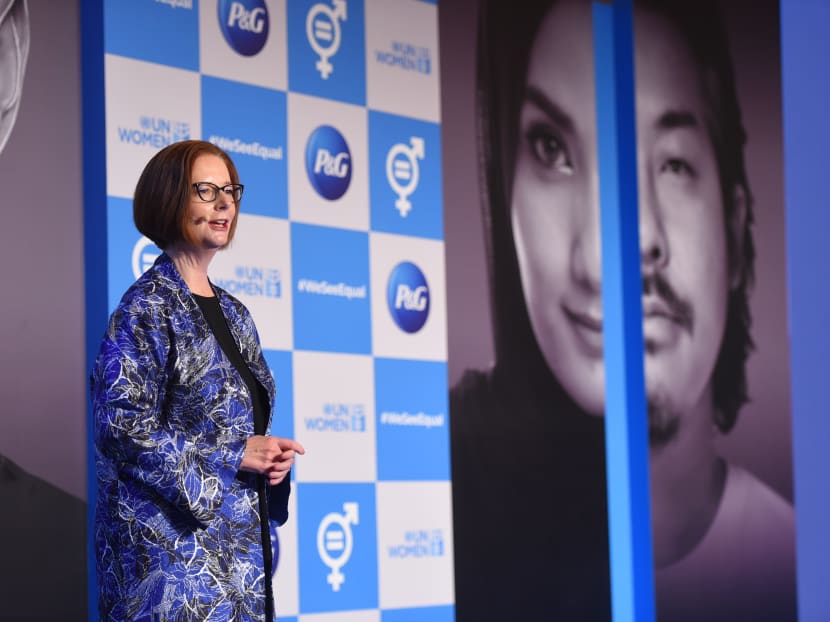
Ms Julia Gillard, former prime minister of Australia, delivering her keynote speech at the P&G Apac #WeSeeEqual Summit 2019.



SINGAPORE — Although elected by her party members to become the first female prime minister of Australia, Ms Julia Gillard felt “lonely” as she was frequently the only woman in the room during meetings.
On one of her earlier international trips after assuming office in 2010, she visited the North Atlantic Treaty Organisation (Nato) headquarters in Brussels, Belgium.
A news report mentioned her “white, short jacket” high up in the story, but did not make similar mention of the attire of then-Nato secretary-general Anders Fogh Rasmussen, who welcomed her during the visit.
Female politicians such as herself also came under criticism for having, or not having children, said Ms Gillard on Friday (May 24) at the Asia Pacific #WeSeeEqual Summit organised by multinational firm Procter & Gamble (P&G).
Into its second year, the conference brings together private and public sector leaders to discuss gender inequality in the workplace.
While mothers are questioned on their commitment to their jobs, those without children, such as herself, were criticised for not understanding mainstream life, she said.
Ms Gillard, whose stint as prime minister lasted until 2013, now chairs the Global Institute for Women's Leadership in King’s College London.
Lamenting the lack of academic research on gender equality, she said: “Given how long we’ve been talking about gender equality and women’s leadership, I would have thought that there were vast libraries full of research for me to dig into and come to understand, but it’s not like that.”
She also highlighted “distressing” statistics about female representation and made note of figures by the World Economic Forum, which found that it would take 202 years for men and women to achieve economic equality, and over a century for the world to achieve political equality.
Calling it “far too long a wait”, Ms Gillard attributed the disparity to unconscious bias and stereotypes about gender.
She also dismissed the “Queen Bee” syndrome, which refers to the stereotype that women who make it to the top do not help other women.
A study by academics from the University of Maryland and Columbia Business School, using data of 1,500 of the largest firms in the United States, showed that once a woman achieved a senior management post, it became 51 per cent less likely for another woman to achieve a similar position.
The same study found that this was because the male chief executive who had hired the first woman thought he had “ticked the box” and fixed the gender inequality problem, Ms Gillard.
‘ASK FOR THE JOB, TAKE THE RISK’
Among issues discussed at the conference was how companies could actively involve men in discussions about gender equality.
One of the panellists, Mr Ralph Haupter, highlighted that in his experience, women were less likely to grab work opportunities than their male counterparts even though they were more qualified.
Mr Haupter, president of Microsoft Asia, called for women to show greater confidence at work. “I encourage you to help the man by being loud, brave, whatever it needs to be. Go into the face of men and ask for a job and take the risk,” he said.
He added that he had instructed his company’s country managers to actively look out for female talent.
Another panellist, Mr Tsuyoshi Morioka, also highlighted that Asian societies — particularly Japan — lagged behind Western countries in gender equality.
The chief executive of Japanese marketing firm Katana Inc recounted attending a meeting the day before with a Japanese car manufacturer. The female vice-director of the company took the coat of the company’s male director, and wiped his desk after he left the room.
Mr Morioka said such traditions have made Japan the least progressive in terms of gender diversity, despite legal efforts to change norms.
It is important for companies to leverage the strengths of women, which could help male leaders avoid “blind spots” in business decisions, he said.
Mr Morioka said that he deliberately hires younger women to tip the balance. “We have to push our artificial hand,” said Mr Morioka. “Otherwise we cannot change the score. That’s my belief.”
Acknowledging that such efforts could create tension in the workplace, Mr Morioka said it was important to maintain accountability and transparency when promoting women, and that all employees need to be aware that such decisions would benefit the company.
Related topics
Australia Julia Gillard Politics gender equalityStay in the know. Anytime. Anywhere.

Subscribe to our newsletter for the top features, insights and must reads delivered straight to your inbox.
By clicking subscribe, I agree for my personal data to be used to send me TODAY newsletters, promotional offers and for research and analysis.






