
PM Lee warns against formation of rival regional blocs, as fresh alignments take shape
SYDNEY — The Asia-Pacific region must avoid the formation of rival blocs or a situation where countries have to pick sides, even as regional powers explore fresh configurations and alignments in a changing strategic environment, Prime Minister Lee Hsien Loong has said.
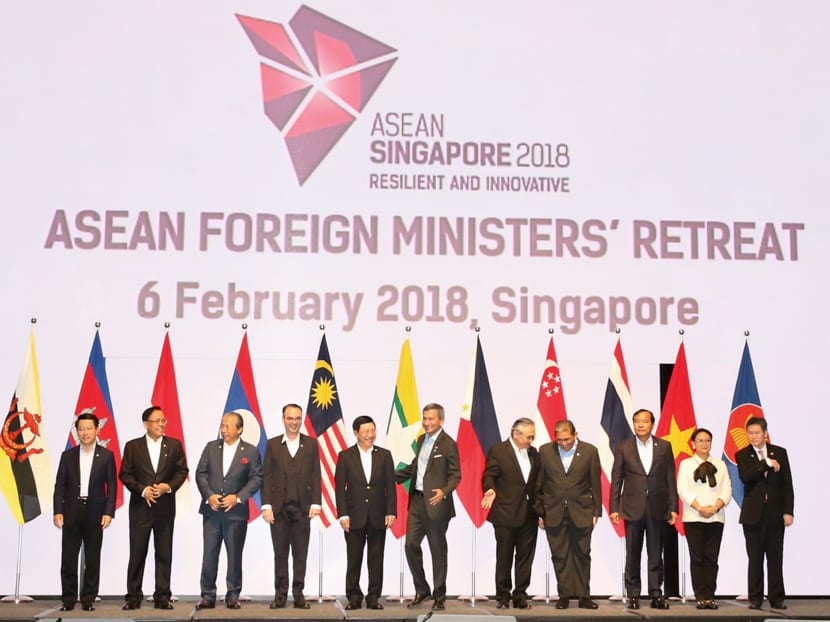
TODAY file photo



SYDNEY — The Asia-Pacific region must avoid the formation of rival blocs or a situation where countries have to pick sides, even as regional powers explore fresh configurations and alignments in a changing strategic environment, Prime Minister Lee Hsien Loong has said.
Mr Lee, who is in Sydney for bilateral and regional meetings, was responding to several questions on regional security from the Australian media ahead of his four-day visit.
Asked for his views on the Quadrilateral Security Dialogue between the United States, Japan, India and Australia, and the Free and Open Indo-Pacific strategy pursued by Japan and the US, Mr Lee said such new or resurrected arrangements are to be expected, given the changing strategic calculations in the Asia Pacific.
"Some of these initiatives will grow, others will evolve in purpose and membership. It is a Darwinian process," he noted. "We hope that the eventual outcome will be an inclusive and open regional architecture, where all countries engage one another peacefully and constructively. We do not want to end up with rival blocs forming or countries having to take one side or the other."
The Quadrilateral Security Dialogue is an informal forum mooted in 2007 that ceased shortly after, only to be revived last year.
Under the Free and Open Indo-Pacific strategy, Japan, for instance, envisages improved connectivity between Asia and Africa across the Indo-Pacific, allowing people, goods, knowledge and capital to move freely. The strategy has been seen as a counterweight to China's Belt and Road trade-and-infrastructure initiative.
While the US has been a key anchor for regional security since the end of World War II, China's influence and interest in the region has expanded as its economy grew, as has India's, though to a smaller extent.
"How these rising powers can integrate into the international system without destabilising it, and how other countries can accommodate legitimate interests of the new powers, will significantly impact regional peace and stability," said Mr Lee.
He noted that the Association of South-east Asian Nations (ASEAN) has played a major role in the regional security framework, adding that the "best way forward" was to strengthen the regional grouping's role and enhance its centrality in partnership with member states and their dialogue partners.
"This will be acceptable to all countries, and will provide a basis for peace, stability and economic development in the region," said Mr Lee, who will join ASEAN leaders for a special summit with Australia this weekend.
SOUTH CHINA SEA DISPUTE
The Australian media also raised questions on the South China Sea dispute, and asked what Australia and Singapore could do to help lower tensions.
"As non-claimant states, it is not possible for Australia or Singapore to solve the problems of the South China Sea," Mr Lee said in response, stressing that the Republic has no claims in the dispute and does not take sides among the competing claimants.
"Interested states can help keep the situation under control by observing international law and international norms, and agreeing to rules which minimise the risk of incidents and escalation," he added.
China asserts sovereignty over much of the South China Sea, amid rival claims from several South-east Asian countries — including four ASEAN members Malaysia, Brunei, Vietnam and the Philippines.
Tensions have eased somewhat in the past year amid regular exchanges between ASEAN member states and China, while negotiations on a code of conduct in the strategic waterway have also begun, said Mr Lee.
He added that Singapore, as ASEAN chair this year and coordinator for ASEAN-China dialogue relations, will work with all parties to "find common ground so that we can manage the disputes and overlapping claims."
"Like Australia, Singapore depends on a peaceful and stable region which supports and promotes free trade and open markets. We share similar outlooks on the importance of international law and the peaceful settlement of disputes," said Mr Lee. "We both have a vital interest in freedom of navigation and overflight in the South China Sea. We should continue to uphold these principles."
Other powers like the US and India similarly have interests in ensuring freedom of navigation in the South China Sea and many parts of the world, and will take their own actions to protect those interests, Mr Lee noted.
He added: "The US, for instance, conducts freedom of navigation operations. They do not consult Singapore. Indeed, China has an interest in freedom of navigation too, not just in the South China Sea, but also notably through the Straits of Malacca."
At a broader level, Mr Lee said the most critical issue, from the region's perspective, is the "political and strategic resolve of the US to project a reliable and constructive presence as a Pacific power".
"At last year's Shangri-La Dialogue, US Defence Secretary James Mattis referred to the Asia-Pacific as a 'priority region' for the new Trump Administration, and affirmed the US' commitment to the region's security and prosperity. Many countries, including Australia and most ASEAN members, support and welcome this US stance," he added.
TERROR THREAT IN SOUTHEAST ASIA
Turning to the terror threat, Mr Lee said he is concerned about the heightened risks posed by returning fighters and those who have been self-radicalised through exposure to the extremist ideology of the Islamic State (IS) militant group.
While IS faces military defeat in Iraq and Syria, its ideology is "far from dead". Fighters from other parts of the world unable or unwilling to return to their home countries may also seek shelter in South-east Asia, which is seen as a "fertile recruitment ground".
A successful attack will also hit the social fabric of South-east Asian countries, many of which are multiracial and multi-religious.
"The damage to societal trust and inter-communal ties would be hard to repair," said Mr Lee, adding that the ramifications could ripple across South-east Asia, including in Singapore, even if the Republic was not under attack.
Australia, where some 100 residents have left to join the sectarian violence in Syria and elsewhere in recent years, has been on the alert for attacks by returning fighters and home-grown militants. In late 2014, for instance, a lone gunman launched an attack on a cafe in central Sydney that resulted in the death of two hostages.
Australia cooperates closely on counter-terrorism matters with Singapore and other regional partners.
A Counter-Terrorism Conference will run on the sidelines of the ASEAN-Australia Special Summit in Sydney this weekend, where officials will discuss how to tie up more effectively to fight terrorism. ASEAN and Australia will also ink a memorandum of understanding on co-operation to combat international terrorism.
Stay in the know. Anytime. Anywhere.

Subscribe to our newsletter for the top features, insights and must reads delivered straight to your inbox.
By clicking subscribe, I agree for my personal data to be used to send me TODAY newsletters, promotional offers and for research and analysis.






