
Resolve differences calmly without inflaming passions, PM Lee urges world leaders at Gandhi commemorative event
NEW YORK — The world must try its best to resolve differences calmly without inflaming passions or hardening attitudes — a philosophy firmly held by the late Mahatma Gandhi, said Prime Minister Lee Hsien Loong on Tuesday (Sept 24).
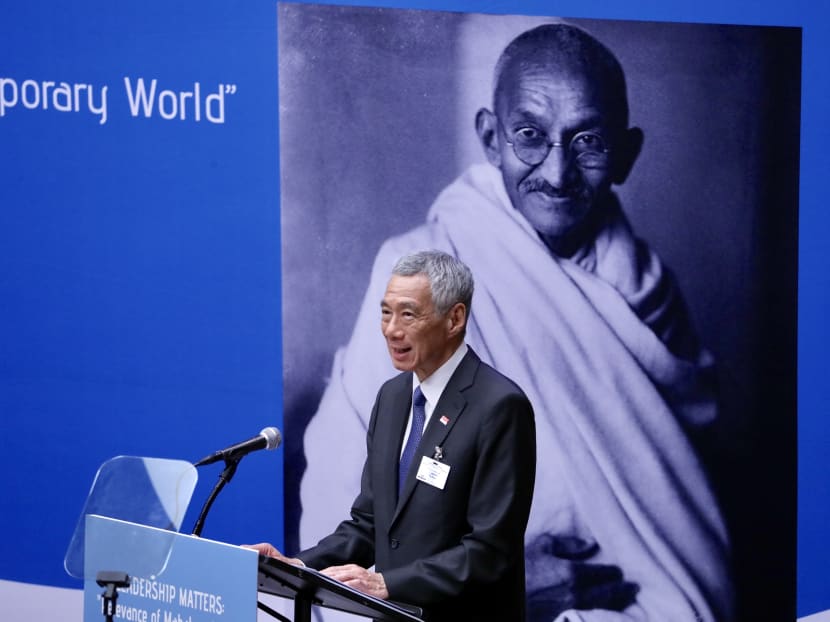
Prime Minister Lee Hsien Loong speaks at the United Nations headquarters in New York.



NEW YORK — The world must try its best to resolve differences calmly without inflaming passions or hardening attitudes — a philosophy firmly held by the late Mahatma Gandhi, said Prime Minister Lee Hsien Loong on Tuesday (Sept 24).
This applies even today, as the world has become more interconnected and diverse, making it easier to amplify differences and for people to take offence more readily, added Mr Lee, who was speaking at the United Nations headquarters in New York.
"Tensions and conflicts are prevalent not just between countries, races and religions, but also within them. But if we take Gandhi’s message to heart, then we must try our best to resolve differences calmly and peacefully, appreciating the views of the other side, without inflaming passions or hardening attitudes," he said.
“In so doing, we will build mutual understanding, tolerance and respect for one another.”
The event titled “Leadership Matters – Relevance of Mahatma Gandhi in the Contemporary World” saw world leaders, such as South Korean President Moon Jae-in and UN Secretary-General Antonio Guterres, speak about Gandhi’s philosophy of non-violent resistance.
Hosted by Indian Prime Minister Narendra Modi, who had invited Singapore to attend, the event was held to commemorate the 150th anniversary of the late Indian leader’s birth on Oct 2 and the legacy he left behind.
When Gandhi was assassinated in 1948, an urn of his cremated remains was immersed in the sea off the southern coast of Singapore, which is where Clifford Pier stands today, Mr Lee told the audience. Mr Modi had visited the spot during his state visit to Singapore last June.
A plaque, unveiled by Mr Modi and Emeritus Senior Minister Goh Chok Tong, now marks the historical spot near Fullerton Bay Hotel where the ceremony was held in accordance with Hindu custom.
“But beyond these physical traces, Gandhi’s ideas and ideals have resonated and endured,” said Mr Lee.
His philosophy of peaceful resistance set India apart from other independence movements of that era, he said.
“He championed non-violence to the core of his being. Even more remarkably, he could persuade his countrymen to desist from violence, even when they had been persecuted and severely provoked,” Mr Lee noted.
Gandhi also believed in the “intrinsic equality” of every person, which resonates with Singapore, Mr Lee added.
Reiterating a part of his speech from Monday, he said Singapore became independent in 1965 based on this principle of equal treatment regardless of race, language or religion.
Since then, Singapore has worked hard to strengthen its social cohesion, expand the common space shared by the different racial and religious groups, and also promote this philosophy on the world stage, said Mr Lee.
Oct 2 — Gandhi’s birthday — has been marked as the International Day of Non-Violence by the United Nations General Assembly (UNGA).
Mr Lee is in New York from Sept 21 to 30 to attend the UNGA, and is leading the Singapore delegation in his first appearance at the annual high-level debates.
Related topics
Lee Hsien Loong Mahatma Gandhi United Nations General Assembly New York Narendra Modi International Day of Non-ViolenceStay in the know. Anytime. Anywhere.

Subscribe to our newsletter for the top features, insights and must reads delivered straight to your inbox.
By clicking subscribe, I agree for my personal data to be used to send me TODAY newsletters, promotional offers and for research and analysis.






