
Single women: Invisible in modern India
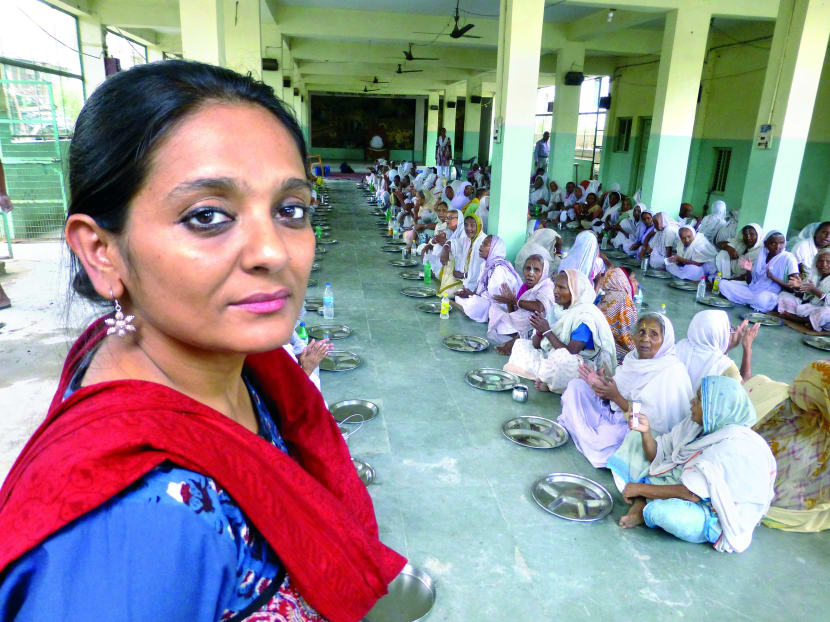
The writer at the sanctuary for widows in the Indian town of Vrindavan. Abandoned by their families, about 15,000 of them have settled in the town. Photo: BBC World News

In her bright frock, with two perfect plaits, Khuddo looked like any other young domestic helper living in rural India. I wondered how old she was. Maybe 10 or 12 years old? She took care of household chores, cleaned utensils, cooked, mopped and preferred to hide behind the curtains.
As she turned and flashed a smile, I looked at her face and realised she was not a young girl. She was a 50-year-old woman and not only any domestic helper — she is a daughter of the family.
She is single and unmarried, so the family sees her as a “tragic case”. In the family set-up, she was not part of the conversation at all, not when we talked about others. No one talked about her too. It was as if she did not exist.
Why was she dressed up like a little girl? She did not answer the question, but her mother did: “She is unmarried, so she should not look or dress like a grown-up woman.”
Meeting Khuddo forced me to think about the state of single women in India. I wondered what Khuddo dreams of. Does she miss her independence or male companionship? Does she not want to express herself as a woman? Does she have sexual desires and has she ever been able to express them?
I did not have answers to any of these. I have not met many single women like her because they are practically invisible in modern India.
It is not very surprising then that there is no legal definition of single women in India. Loosely speaking, they include divorced and separated women. There is still no clarity over whether unmarried women are part of the family or have any status as individuals.
According to the census data of 2001, there were 39.8 million such women falling into the category of single women, which included those above the age of 30 who were divorced, separated or unmarried, but this is considered an extremely conservative figure.
In my journey of trying to understand the social and legal status of this growing chunk of the population, I was shocked to realise how we, as a society, know so little about what it means to be a single woman.
While filming the documentary, India’s Invisible Women for BBC World News, I met Suruchi, a 29-year-old IT professional, who had been living in Mumbai for the past five years. She is a lively young woman who wants to live life on her own terms. I asked her how it was like to be living alone as a single, unmarried woman in Mumbai. She said: ‘It’s intense. You actually live a life where you are scared all the time. You’re not yourself! At least as a single woman, that’s what I’ve faced over the last five years in this city. Constantly.”
In the past five years, Suruchi has moved house five times. She said the biggest hurdle is to find a place to live. Her estate agent, Melvin, explained why it is such a huge problem, even in a cosmopolitan city such as Mumbai. “People in India normally get married at the age of 22 or 23 and, if a woman is unmarried, society believes she is someone with a bad character. They imagine she could be running a prostitution racket in her house or doing drugs and see her as a bad influence on children,” he said. “It becomes really hard for a single woman to have an apartment. Often, it’s a complete no. The doors are closed.”
The few places that may tolerate a single female tenant tend to be in expensive international districts, well beyond an ordinary budget. In addition, owners are keen to cover what they see as an increased liability with higher rent than normal.
Without a man, the Indian woman is seen as inherently vulnerable, to be safely hidden behind security bars. However, she is also seen as a threat to morality and that is another reason to restrict her freedom.
It is one thing to be single by choice. But what about women who find themselves single through no fault of their own? The plight of widows in this country is exemplified in a town called Vrindavan, which is also considered a holy city. This is the place where thousands of widows come every year as they have been abandoned by their families. It is a city of narrow, crowded alleyways, shrines and holy baths where the devoted purify themselves.
The sanctuary here has attracted about 15,000 women, whose grief at losing their husbands has been compounded by what has followed: Often seen as a burden emotionally and financially by their families, they have suffered resentment, abuse and, ultimately, abandonment.
I met one of them: Shakdi Dasi, 65, who came to Vrindavan eight years ago after life as a widow living with her family became unbearable. She lives in a small brick shack in a compound, impoverished and alone.
She told me her story as tears welled up in her eyes and her voice choked: “When my husband was alive, I had his protection. Then he died and I was like an orphan. My sons and daughters-in-law no longer cared about me. There was no one left for me and no point for me to be in this world. It hurt my pride and my self-respect. I said to myself, ‘I don’t want to see their faces again.’ Whenever I got abused, I felt very sad and would start crying. I came into this life as a queen; now, I have been reduced to a beggar.”
Like many of the widows in Vrindavan, who are mostly from rural and poor backgrounds, Shakdi had little to lose in coming here. The life which she had taken decades to create had already been taken from her.
Winnie Singh is a social activist who has been working for the widows in Vrindavan. I spoke to her about why these women were pushed out by their families. She said the primary reason is economic — a widow is an extra mouth to fill. Families also feel they can get hold of her property rights without resistance from her.
Winnie said the fact that these widows do not resist the way they are treated by their families is deeply rooted in culture. “They still hope that, when they die, their son will come and light their pyre. Only if your son lights your pyre will you go to heaven. A son who breaks your legs, hits you so hard that your skull breaks and is willing to put cow dung in your mouth; yet, you want him to light your pyre.”
Living in India, one realises that breaking old cultural habits is not easy, but also not impossible. There are more women choosing to be single despite pressures that stem from the same source — the long-held cultural and social belief in the country that a woman without a man is somehow of less value.
Some of the hardest truths to face are those closest to home. Many things in India are improving, but the bottom line is: The nation remains an unforgiving place for women who need the freedom to be single.
ABOUT THE AUTHOR:
Rupa Jha is a BBC World News and BBC World Service presenter. She hosts the programme India’s Invisible Women.
Stay in the know. Anytime. Anywhere.

Subscribe to our newsletter for the top features, insights and must reads delivered straight to your inbox.
By clicking subscribe, I agree for my personal data to be used to send me TODAY newsletters, promotional offers and for research and analysis.






