
Some Cathay Pacific businesses to forgo Covid-19 wage relief from Hong Kong government, paving way for lay-offs
HONG KONG — The Cathay Pacific Group will apply for a limited amount of help from the Hong Kong government’s wage subsidy scheme, the Post has learned, in a closely watched move indicating how soon it can lay off staff during the coronavirus pandemic.
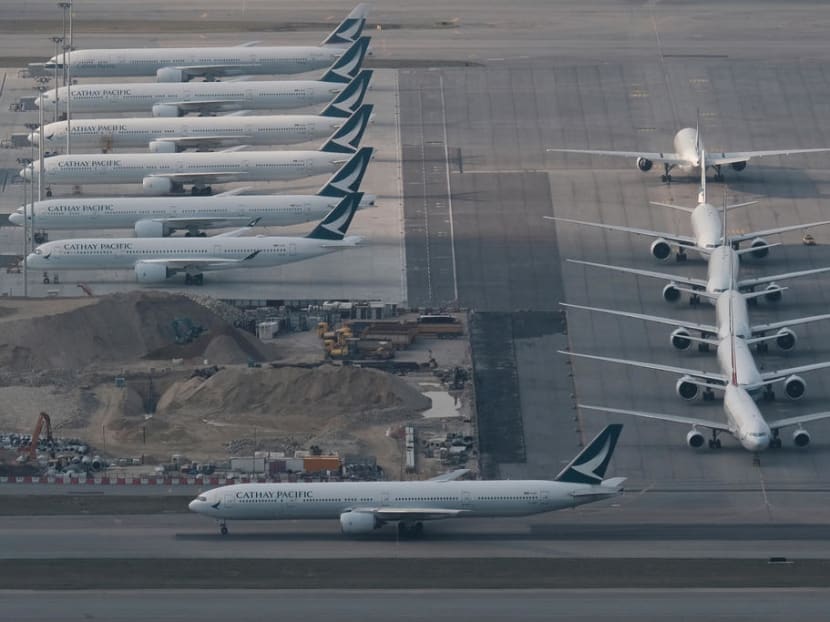
Cathay’s daily passenger traffic has collapsed by 99 per cent and it has grounded most passenger flights, scrapping most of its schedules.

HONG KONG — The Cathay Pacific Group will apply for a limited amount of help from the Hong Kong government’s wage subsidy scheme, the Post has learned, in a closely watched move indicating how soon it can lay off staff during the coronavirus pandemic.
But some of Cathay’s nine major business units will not tap the latest round of the Employment Support Scheme (ESS) in a decision to be unveiled on Friday (Sept 11), according to an individual with knowledge of the plans.
Analysts noted that by forgoing more wage help, the Cathay businesses are free to reduce headcount as early as next month as part of a wider restructuring to adapt to a changed future that will see far fewer staff, flights or planes needed for at least four years.
Salaries accounted for a quarter of the company’s operating expenses in the first six months of this year.
Singapore Airlines, a benchmark for premium airlines in Asia such as Cathay, announced on Thursday it would eliminate 4,300 jobs – 15 per cent of its workforce. After a hiring freeze, early retirement and natural attrition, the airline said it still needed to cut another 2,400 positions.
Companies participating in the ESS, launched to ease the economic blow from the coronavirus pandemic and now in its second round, must not make redundancies.
If some Cathay subsidiaries do not sign up again, lay-offs could begin in October. Otherwise, any redundancies will be put off until at least December.
“From a purely economic perspective, Cathay certainly should not sign up for round two because doing so will only slow down its restructuring process,” said Morningstar analyst Ivan Siu.
“But now that the Hong Kong government has become a significant shareholder of Cathay, it makes me wonder if the airline will need to fulfil some social responsibilities like its mainland peers.”
The company in June unveiled a HK$39 billion (S$6.87 billion) recapitalisation effort that included HK$27.3 billion from the government.
On Aug 13, a day after the company posted a HK$9.87 billion loss in the first six months of 2020, the company told staff it had yet to decide on seeking further government help for wages.
“It is under careful consideration and we are currently evaluating all feasible options to ensure we remain competitive in the new global aviation landscape,” it said.
Under the HK$81 billion coronavirus relief scheme first announced in March, the government is offering to pay 50 per cent of employees’ salaries for six months, capped at HK$9,000 per worker each month.
In the first round of the scheme covering June to August, the airline and its subsidiaries, which include cargo, frequent flier and laundry businesses, received HK$707 million for 26,907 staff out of 33,000 in total.
“I think it might be a chance (to apply for the ESS again),” said Mr Kelvin Lau, head of auto, transport and industrial research at Daiwa Capital Markets. “If it is extra money, yes of course they need cash.”
He noted the scheme’s restrictions would weigh upon the timing of the job cuts.
Mr Luya You, transport analyst at brokerage Bocom International, said: “Cathay would be happy with whatever additional support they can get right now. Given the state of operations, any additional funding to offset staff expenses would be helpful in delaying cuts.”
The airline in March asked employees to sign up for unpaid leave to be taken over nine months, with 80 per cent agreeing in a first round and 90 per cent during a second one.
With most planes grounded, fewer staff are needed to operate flights, which has reduced salary costs.
More than 400 cabin crew departed in June after the company closed its North American cabin crew bases.
Mr Augustus Tang Kin-wing, Cathay's chief executive, said in July its strategic review to determine its future size and shape would balance the interests of all stakeholders. But he warned in August that its recapitalisation required a return to profit to pay down its bailout.
Airlines across the world have teetered on the edge of collapse, with border closures sapping demand for air travel. Cathay’s daily passenger traffic has collapsed by 99 per cent and it has grounded most passenger flights, scrapping most of its schedules.
It also emerged this week that it might send half its planes for long-term storage abroad as it braces for a difficult winter amid slow recovery. SOUTH CHINA MORNING POST
Related topics
Covid-19 coronavirus Cathay PacificStay in the know. Anytime. Anywhere.

Subscribe to our newsletter for the top features, insights and must reads delivered straight to your inbox.
By clicking subscribe, I agree for my personal data to be used to send me TODAY newsletters, promotional offers and for research and analysis.






