
As spectre of anti-Asian violence grows, I’m doing all I can to keep my family safe: S’porean in the US
Last week’s deadly shooting rampage at spas in Georgia in the United States, which killed six Asian-American women, has thrown a spotlight on violence against Asians in the country. The incident, which is the latest in a spate of hate crimes, has also caused unease among some US-based Singaporeans.
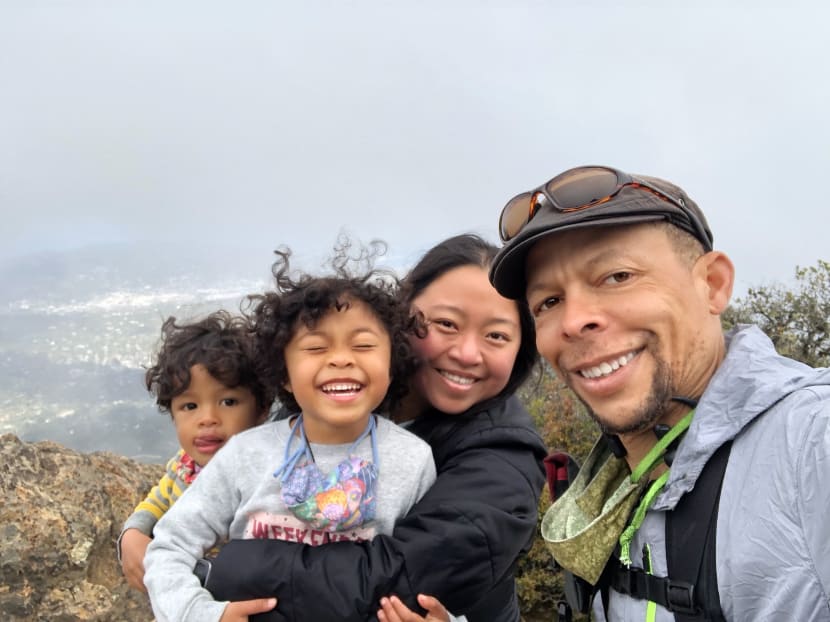
Singaporean Pearly Tan Li Lin (second from right) moved to the United States in 2012. She is pictured here with her family.

Last week’s deadly shooting rampage at spas in Georgia in the United States, which killed six Asian-American women, has thrown a spotlight on violence against Asians in the country. The incident, which is the latest in a spate of hate crimes, has also caused unease among some US-based Singaporeans.
Singaporean Pearly Tan, who lives in the US with her young family, has seen racism up close. She describes her encounters over the years and the steps she has taken to protect herself and her family.
On Sunday (March 21) evening, I put on a beanie, headphones and raincoat to go for a walk.
It was supposed to help me relax after a day of working from home. Instead, I was constantly afraid that I would be attacked from the side or behind, or approached from blind spots.
Downtown Berkeley, with its many university students, used to bustle with life before the Covid-19 pandemic.
Yet it was isolated and quiet.
I adjusted my walking route to avoid the few people who were out and seemed unstable. They were shouting mostly to themselves.
But I met one of them again on my way home and she was holding a stick.
I had forgotten to take along my pepper spray and stun gun.
It is at times like this when I do not know if making eye contact with a potential threat would trigger an attack.
I am part of a mixed-race family in the US.
My husband is Black and we have two “Blasian” children (those with African and Asian heritage), aged five and two.
When I first saw news of the recent shootings at spas in Georgia, which killed six women of Asian descent, I chose not to read further.
I was in the middle of my work day and did not want to feel the emotions I knew would surface.
I have felt them each time a Black person or child has been wrongfully murdered in the US, and wondered how else I could protect my husband and children.
With the continuous spate of violence against minorities in the US, our family needs to be deliberate about when we open ourselves to the fear and anger that come with reading about others like us losing their lives.
For the first time, with the recent shootings, I saw a murder victim with the same last name as mine.
I am concerned that this recent shooting, which the gunman claimed was sexually motivated, would only be the start of more violence against Asians.
The larger problem that has been brought to the fore, however, is the sexualisation of Asian women by white men.
When I first moved to the San Francisco Bay Area in 2012, I was frequently the subject of catcalls.
In San Francisco, a guy said “slanted eyes and juicy thighs” as I walked by.
Today, that permission to harass Asians in public spaces has pivoted only slightly to include a veiled anger that has built up over the years, due to American leaders’ regurgitation of the “model minority” myth that encourages other minorities to see us as the “other”.
Former president Donald Trump’s repeated rhetoric that Covid-19 came from the Chinese did not help.
EVERYDAY RACISM
I am very much alive to the racism that pervades the US.
Last year, I was at a farmers’ market in Berkeley, where I picked up a sealed box of cherries and put them down.
A white man began yelling at me, loud enough for everyone in the area to hear how I was “disgusting” (with an expletive thrown in) and the reason for the pandemic.
I walked away, but he and his partner followed me to another store. I eventually left.
At least 20 people witnessed the incident, but no one said or did anything.
After that, I did not go to the farmers’ market for months.
I did not even want to go grocery shopping, so my husband had to do it.
Our family has experienced other threats of racial violence.
It is hard to describe the myriad of feelings that coursed through me the day my children and I were spotted by a racist white man who threatened our family.
As he shouted vulgarities from across the street, I made sure my children walked close beside me and away from his vitriol. It was the best I could do.
This was pre-pandemic and the area was crowded but, again, no one intervened.
When he was distracted for a moment, I grabbed my kids and weaved us into a crowd and then whisked them down a side street.
Since last year, I have also been acutely aware of how seniors in the Asian community here have been violently attacked as they went about their daily activities.
Waiting to cross a street should not be a scary affair.
I am extremely thankful that my parents are in Singapore and not living through this in the US.
To be sure, I have had positive encounters, too.
For example, in my workplace, several people have reached out to offer support. Safe spaces have been created for me to share my authentic feelings and concerns.
From town halls and virtual meetings to chat groups for Asian-Americans and Pacific Islanders, some of my colleagues and friends truly care and I will not waste time running after those who do not.
SELF-DEFENCE
With the increased violence against Asians, the least I can do is continue as we have.
Because of the pandemic, we have mostly kept a safe distance from friends and family, which also means that we do not spend much time in public where others gather.
But when I must go out, I am more likely to carry a self-defence tool and much more likely to intervene if I see someone being attacked.
Short of owning a gun over concerns about misfires, especially with our young children, we have taken many precautions to reduce our risks — from taking self-defence classes to having a steel bat by the entrances to our home.
I have come to accept that this is life in America.
ABOUT THE WRITER:
Ms Pearly Tan Li Lin, 33, is a content designer with social network Facebook. She moved to the US in 2012 and is based in Berkeley, California.
Related topics
racism Asian Atlanta spa shooting overseas Singaporean USAStay in the know. Anytime. Anywhere.

Subscribe to our newsletter for the top features, insights and must reads delivered straight to your inbox.
By clicking subscribe, I agree for my personal data to be used to send me TODAY newsletters, promotional offers and for research and analysis.






