
Trapped vessels start to move out of Baltimore following bridge disaster
BALTIMORE — The Port of Baltimore opened a temporary channel on Monday (April 1), freeing some tugs and barges that had been trapped by last week's bridge collapse, but officials said wider restoration of commercial shipping remained frustrated by unyielding conditions.
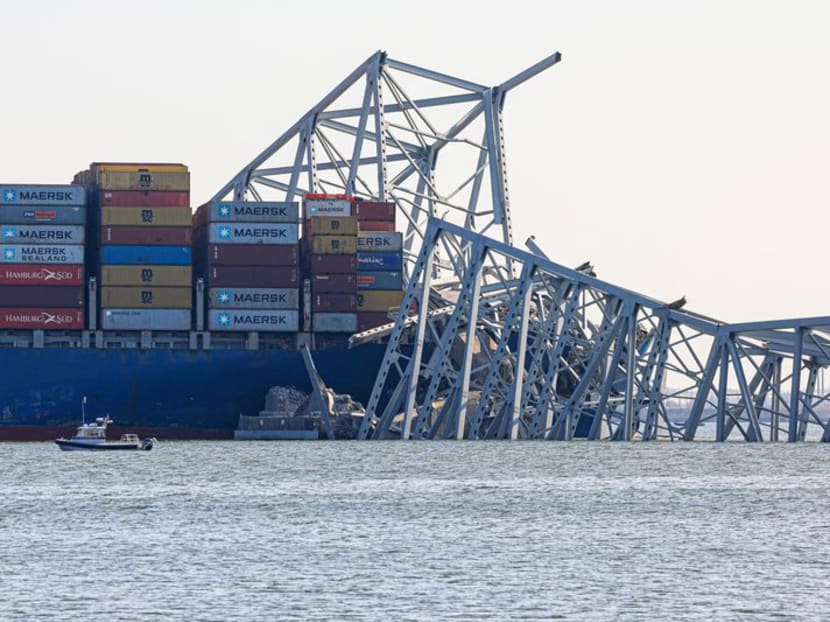
Wreckage lies across the deck of the Dali cargo vessel, which crashed into the Francis Scott Key Bridge causing it to collapse, in Baltimore, Maryland, US, on March 29, 2024.

BALTIMORE — The Port of Baltimore opened a temporary channel on Monday (April 1), freeing some tugs and barges that had been trapped by last week's bridge collapse, but officials said wider restoration of commercial shipping remained frustrated by unyielding conditions.
Baltimore's shipping channel has been blocked since a fully loaded container ship lost power and collided with a support column on the Francis Scott Key Bridge last Tuesday, killing six road workers and causing the highway bridge to tumble into the Patapsco River.
A recovery team led by the US Coast Guard and the state of Maryland aims to quickly reopen the port, the largest in the US for "roll-on, roll-off" vehicle imports and exports of farm and construction equipment.
But first it must free the cargo vessel Dali, stuck under steel bridge debris with 4,000 containers and a 21-member crew aboard who have been stranded on the ship since last week.
To illustrate the task ahead, officials said recovery workers needed 10 hours to cut free and remove a 200-tonne piece of debris — what they called "a relatively small lift".
"We're talking about something that is almost the size of the Statue of Liberty," Governor Wes Moore told a news conference. "The scale of this project, to be clear, is enormous. And even the smallest (tasks) are huge."
Beneath the surface, the job is even more complicated than originally imagined, said US Coast Guard Rear Admiral Shannon Gilreath, as the twisted steel is obscured by murky waters darkened by the volume of debris.
"These girders are essentially tangled together, intertwined, making it very difficult to figure out where you need to potentially cut so that we can make that into more manageable sizes to lift them from the water," Mr Gilreath told the same news conference.
Officials declined to estimate how long it would take to clear the harbor given the scale of the disaster.
Limited ship traffic resumed for the first time on Monday after recovery teams opened a temporary channel with a controlling depth of 3.35m on the northbound side of the wreckage. Mr Gilreath said he did not know if those vessels carried goods out of the harbour or were empty and seeking to reload elsewhere.
A second temporary channel on the southbound side with a depth of 4.6m to 4.9m would open "in the coming days", Mr Moore said.
Once debris is cleared, a third channel was planned with a depth of 6.1m to 7.6m that would allow almost all tug and barge traffic in and out of the port, Mr Gilreath said.
US President Joe Biden will get a first-hand look at the recovery on Friday when he travels to Baltimore, White House spokesperson Karine Jean-Pierre said.
The Biden administration has helped secure barges and a crane along with an early influx of money and was working with Congress to ensure the federal government pays to rebuild the bridge. REUTERS
Related topics
United States bridge collapseStay in the know. Anytime. Anywhere.

Subscribe to our newsletter for the top features, insights and must reads delivered straight to your inbox.
By clicking subscribe, I agree for my personal data to be used to send me TODAY newsletters, promotional offers and for research and analysis.






