
US Federal Reserve holds key rate, still sees 3 cuts in 2024
WASHINGTON — The US Federal Reserve voted on Wednesday (March 20) to keep interest rates at a 23-year high for a fifth consecutive meeting, while signaling it still expects to make three cuts this year.
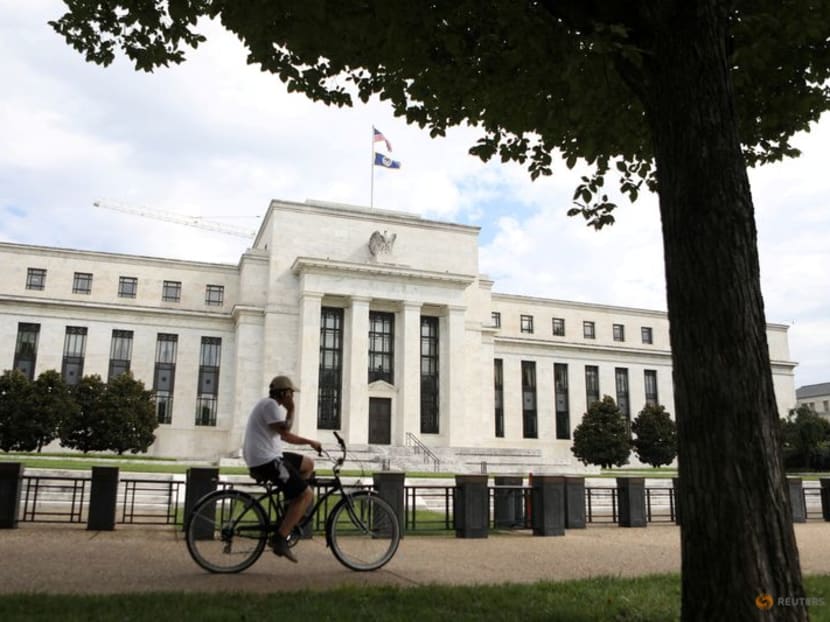
A cyclist passes the Federal Reserve building in Washington, DC, US, on Aug 22, 2018.

WASHINGTON — The US Federal Reserve voted on Wednesday (March 20) to keep interest rates at a 23-year high for a fifth consecutive meeting, while signaling it still expects to make three cuts this year.
The news sent US markets higher, as traders cheered the central bank's affirmation that three cuts are likely despite a recent uptick in monthly inflation.
All three major indices on Wall Street closed at new records.
The Fed's unanimous decision to hold its key lending rate between 5.25 per cent and 5.50 per cent lets policymakers "carefully assess incoming data, the evolving outlook and the balance of risks", it said in a statement.
Last year, the Fed's policies proved to be a success: Inflation eased dramatically from the multi-decade highs seen in 2022 toward its long-term 2 per cent target, while the United States was able to avoid a widely predicted recession thanks to unexpectedly strong economic growth.
But 2024 has been more challenging, with the first two months of data pointing to a small rise in the pace of monthly inflation — renewing fears that interest rates will have to remain high for longer to bring prices under control.
"Inflation is still too high," Fed chair Jerome Powell told reporters after the rate decision was published, adding: "ongoing progress in bringing it down is not assured, and the path forward is uncertain".
But despite the recent rise, Mr Powell said this year's inflation data "haven't really changed the overall story, which is that of inflation moving down gradually on a sometimes bumpy road toward 2 per cent".
GROWTH FORECAST LIFTED
Alongside its rate decision, Fed policymakers also updated their economic forecasts on Wednesday, sharply upgrading the US growth outlook for this year to 2.1 per cent, from 1.4 per cent in December.
Fed officials left the headline inflation forecast unchanged, but slightly raised the outlook for annual so-called "core" inflation — which excludes energy and food prices — to 2.6 per cent.
The members of the rate-setting Federal Open Market Committee (FOMC) also left the median projection for interest rates at end-2024 at the midpoint between 4.50 and 4.75.
This means they still expect 0.75 percentage points of cuts before the end of the year, which would likely translate into three 0.25 percentage point cuts.
In the run-up to Wednesday's decision, some analysts had predicted that the inflationary picture could lead the FOMC to reduce the number of cuts they expect to see this year from three to two — something that ultimately did not materialise.
"The Fed delivered a straightforwardly dovish message: rate cuts are coming even if inflation or growth run stronger than expected," economists at Citi wrote in a note to clients after Mr Powell's press conference had concluded.
CHANGE OF TUNE
Futures traders currently assign a probability of more than 70 per cent that the Fed will start cutting interest rates by mid-June, with that number rising to more than 85 per cent by the end of July, according to data from CME Group.
"We continue to expect the first cut from the Fed in June," the Citi economists wrote, forecasting as many as five cuts this year on the assumption that the hot US labour market weakens in the months ahead.
Others expect a less aggressive pace of cuts, with economists at Wells Fargo predicting a total of four this year, with the first in June.
"However, with the committee more upbeat on prospects for economic activity and a bit more worried about inflation, the risks to our outlook are skewed toward the FOMC beginning to ease a little later in the summer (at its July 31 meeting), or potentially proceeding at a slower pace," they wrote in a note to clients.
Mr Powell also said on Wednesday that the Fed expects "fairly soon" to start slowing down the pace at which it is selling off assets it acquired to help the economy weather the Covid-19 pandemic.
Such a move would reduce the chances of another liquidity crisis, and could actually allow the Fed to do more over the longer term to reduce its swollen balance sheet, Mr Powell said.
"It's sort of ironic that by going slower, you can get farther," Mr Powell said. "But that's the idea." AFP
Related topics
US Federal Reserve Jerome Powell InflationStay in the know. Anytime. Anywhere.

Subscribe to our newsletter for the top features, insights and must reads delivered straight to your inbox.
By clicking subscribe, I agree for my personal data to be used to send me TODAY newsletters, promotional offers and for research and analysis.






