
US hopes Japanese navy will be more active in Pacific
YOKOHAMA — As Japan remains divided over proposed changes in the role it should play in regional security issues, senior United States and Japanese military officers say they hope the Japanese navy may soon be freed up to play a more active role in the Pacific and beyond, plying some of the world’s most hotly-contested waters.
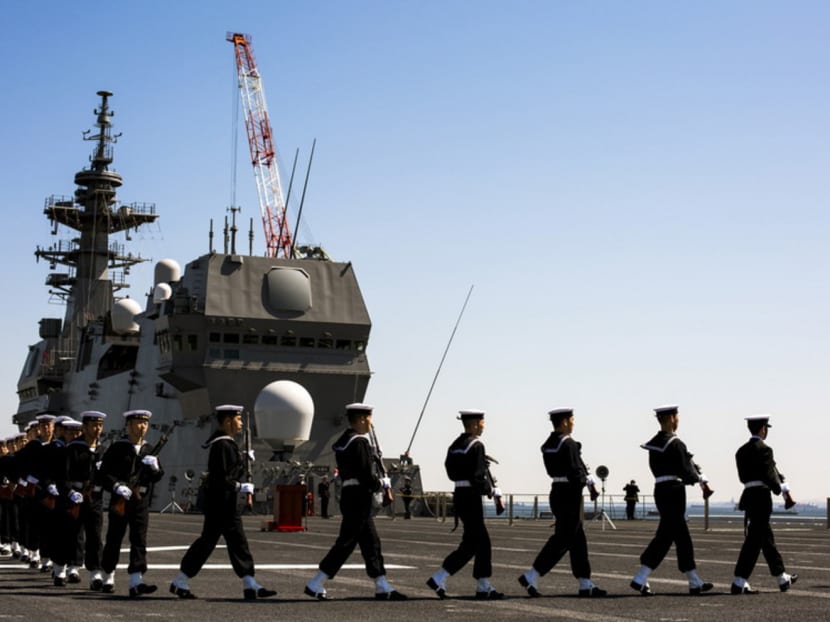
Japan is setting up an amphibious unit similar to the US Marines and is also planning to upgrade its air defences with F-35 stealth fighters and Global Hawk drones. Photo: REUTERS

YOKOHAMA — As Japan remains divided over proposed changes in the role it should play in regional security issues, senior United States and Japanese military officers say they hope the Japanese navy may soon be freed up to play a more active role in the Pacific and beyond, plying some of the world’s most hotly-contested waters.
Vice-Admiral Robert Thomas, commander of the US Seventh Fleet, said he expects revisions headed for approval in Japan’s Parliament will make it easier for the Japanese and American navies to cooperate more smoothly in the Indian and Pacific oceans and in “multilateral exercises across the region”.
The proposed guidelines are important to Washington because Japan is the US’ closest and most stalwart ally in Asia. They come as Japan is already shifting its defence priorities from northern reaches near Russia to the East China Sea, where Tokyo and Beijing are locked in a dispute over a chain of uninhabited islands.
Japan is setting up an amphibious unit similar to the US Marines to respond quickly to any invasion of those islands and is also planning to upgrade its air defences with F-35 stealth fighters and Global Hawk drones.
One of the key strategic goals for Tokyo and Washington is to allow Japan to participate in what is known as collective self-defence, meaning that it would be able to come to the aid of an ally under attack even if that did not entail a direct attack on Japan or its own military.
“They have the capacity and the capability in international waters and international airspace anywhere on the globe. That’s the important point,” Admiral Thomas told reporters.
“The decisions that are pending with regard to collective self-defence will clearly allow the Japan Maritime Self-Defence Forces to interact with, frankly, a lot of international partners, not just the US Seventh Fleet, in a more flexible fashion.’’
China’s air force recently held its first exercise in the western Pacific Ocean, reportedly conducting drills between Taiwan and the Philippines.
According to the Japanese Defence Ministry, Japanese fighters are also on track to set a new high for emergency scrambles against airspace incursions, increasingly by Chinese aircraft.
Japanese Prime Minister Shinzo Abe, wary of the expansion of the Chinese military, has been a major advocate of loosening post-war restrictions on Japan’s military.
Tokyo and Washington both want Japan to be able to send its troops farther from its shores with fewer restrictions and join in a wider range of activities, from humanitarian operations to exercises in more locations and with a broader range of partners.
“There are areas that we can’t now do in a seamless way (with the Seventh Fleet), so we hope that these areas will be improved in the process of formulating the guidelines,’’ said Vice-Admiral Eiichi Funada, commander of the Japanese fleet.
He said that Japan has been very concerned with the expansion of the Chinese military in recent years.
“Their recent exercises were also a matter of attention for us. We are not sure what the exact significance of the exercises was, but as part of the expansion of the Chinese military, it is something that we must watch with caution and continue to collect intelligence on.’’ AP
Stay in the know. Anytime. Anywhere.

Subscribe to our newsletter for the top features, insights and must reads delivered straight to your inbox.
By clicking subscribe, I agree for my personal data to be used to send me TODAY newsletters, promotional offers and for research and analysis.






