
WHO chief: what rest of world can learn from China's fight against Covid-19
HONG KONG — Mr Bruce Aylward, the leader of World Health Organization (WHO) team that visited the country earlier this month, arrived in the country amid widespread scepticism about its efforts to stop the spread of Covid-19.
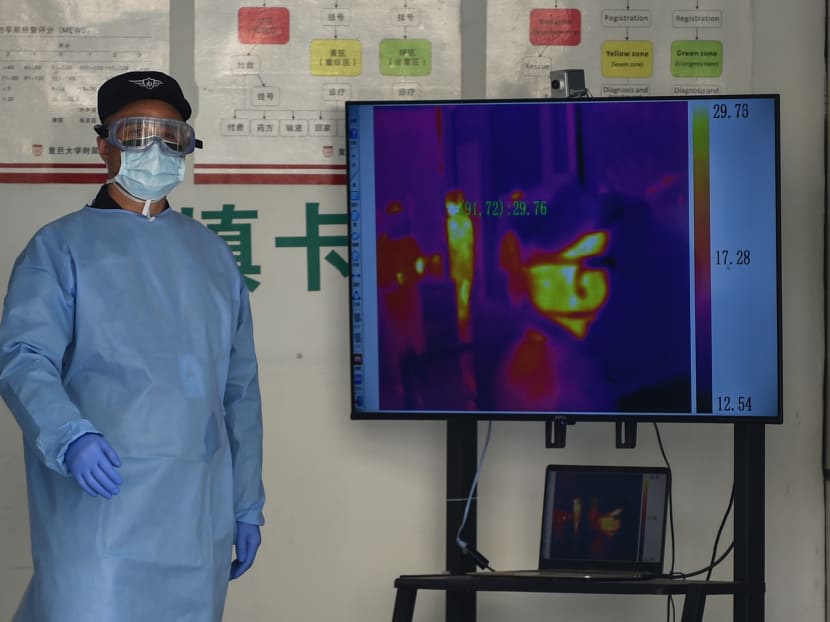
A security guard wearing protective clothing is seen next to footage from a thermal camera at an access point to Huashan Hospital in Shanghai on Feb 27, 2020.

HONG KONG — Mr Bruce Aylward, the leader of World Health Organization (WHO) team that visited the country earlier this month, arrived in the country amid widespread scepticism about its efforts to stop the spread of Covid-19.
But by the end of the visit he was telling the world that its "aggressive" and "tailored" approach, including "old-fashioned" methods could teach the rest of the world valuable lessons.
"It's not to praise China, it's to open the door, and have the rest of the world realise there is something that can be done as people are starting to despair over what can we do," Mr Aylward told a press conference in Beijing on Monday.
"What China has demonstrated is, you have to do this. If you do it, you can save lives and prevent thousands of cases of what is a very difficult disease."
More than 3,000 cases of coronavirus infection have now been reported outside mainland China, including 54 deaths.
A small WHO team made a brief visit to China before Mr Aylward, a senior adviser to the WHO director general, put together the team of 12 experts in epidemiology, virology, and public health that made a fuller tour of the country in February to see what lessons the rest of the world could take from China's response to the crisis.
The team visited Beijing, Guangdong, and Sichuan between Feb 16 to Feb 20 with a group of Chinese specialists before moving on to Wuhan, the centre of the epidemic.
Wuhan, and most other cities in Hubei, have been locked down due to worries about community transmission clusters.
Other parts of the country adopted a range of measures to stop the spread of the disease, such as close contact tracing and quarantine, as well as lockdowns of various degrees of severity.
But there has also been a focus on basic hygiene, with campaigns to promote practices such as regular handwashing and mask-wearing.
Mr Aylward said many were still ambivalent about adopting a non-pharmaceutical approach and said countries needed to work with the methods they have — there is no vaccine available — in the face of an "extremely dangerous" and potentially "devastating" virus.
There has been a rapid fall in the number of new cases reported in China, from around 2,500 a day at the start of Mr Aylward's visit to the low hundreds more recently, a fall of 80 per cent. But questions have been raised about whether this is down to under-reporting, or changes to the reporting criteria.
But Mr Aylward backed the conclusion that China had turned the situation round.
He said the 12 members of his team "work for the best institutions, research facilities and public health institutions around the world. They want to be convinced."
He continued: "Very rapidly, multiple sources of data pointed to the same thing that the cases are falling and it's falling because of the actions that are being taken." For instance, he said, visits to fever clinics had fallen significantly — a possible sign that fewer people were falling ill.
But he also said other countries should learn from the mistakes China made, including the slow response when the disease first emerged in Wuhan.
He described it as a "really sour and horrific" lesson for China, adding: "What worries me most is: has the rest of the world learned the lesson of speed? We have outbreaks in multiple countries right now, increasing at exponential growth rates … It's devastating."
He said other countries needed to act quickly and apply rigorous methods, which did not necessarily include lockdowns, when the disease first appeared before it starts spreading in low-income countries with a weak public health capacity.
Mr Aylward also accepted that China's draconian response was only possible because of the nature of its government and the "tremendous collective commitment and will of the Chinese people".
But he admitted that the rest of the world was "not yet ready in mindset or with the materials" to adopt China's approach. SOUTH CHINA MORNING POST
Related topics
China World Health Organization Wuhan virus coronavirus Covid-19Stay in the know. Anytime. Anywhere.

Subscribe to our newsletter for the top features, insights and must reads delivered straight to your inbox.
By clicking subscribe, I agree for my personal data to be used to send me TODAY newsletters, promotional offers and for research and analysis.






