
The Big Read: Singles ready to mingle, but settling down is a different matter amid choices galore
SINGAPORE — In January, Mr Alan Wong came across a “pleasant-looking girl” on Coffee Meets Bagel, a popular dating application, and they began texting.
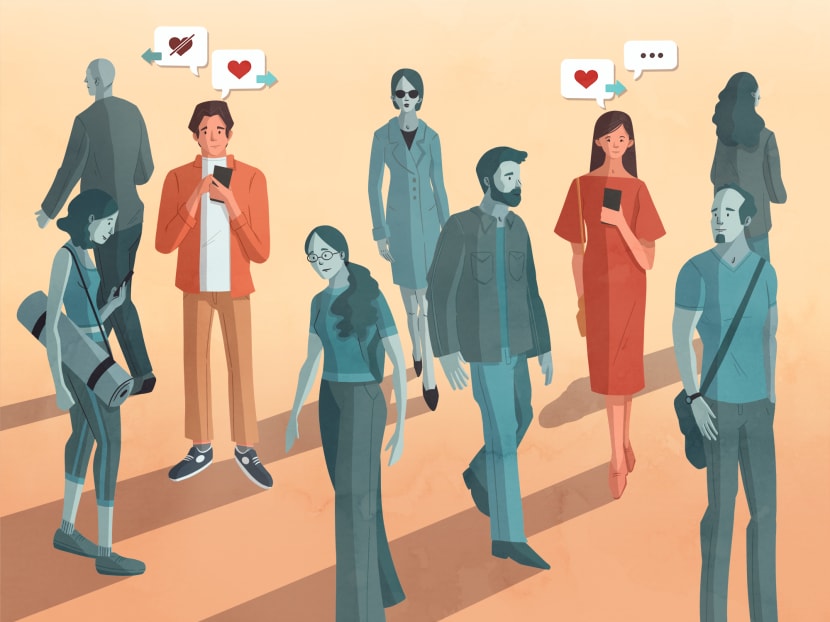
A survey conducted by the National Population and Talent Division (NPTD) from July to August last year found that more than half of single respondents went on dates at least once a week.



- Rise of online dating has helped time-starved S’porean singles meet new people more easily
- With socialising disrupted by Covid-19, online dating has become an even greater boon for singles
- Despite actively dating, the age at which S’poreans get hitched continues to rise
- Experts said that singles simply have too many options, making it harder to decide who to marry
- There also remains a small group who hope to meet their partner by “fate”
SINGAPORE — In January, Mr Alan Wong came across a “pleasant-looking girl” on Coffee Meets Bagel, a popular dating application, and they began texting.
The more they exchanged messages online, the more the civil servant felt that she was unlike any other girl he had met before.
She works in a technology company, a field that he is interested in.
She is also a seasoned traveller to Europe and an avid skier, while he has always wanted to ski. “I like snowscapes and her interest resonated with me,” recounted Mr Wong, 26.
But their first offline meeting at a Japanese restaurant in Buona Vista after a month of texting changed everything; whatever the pair had going on between them completely fizzled out.
“It appeared as if my date had used a picture from way before… She looked way different in real life,” said Mr Wong.
Their one-hour dinner was peppered with many awkward silences. “The level of energy was simply not the same when we spoke face to face,” he said.
That was the last time he went out with her.
A less than satisfying first encounter with a date such as Mr Wong’s is not unusual with the rise of online dating, which has helped time-starved S’porean singles meet new people more easily.
In recent months, with socialising disrupted by the Covid-19 pandemic, online dating has become an even greater boon for singles ready to mingle.
Mr Aqil Hamzah, 23, a second-year student at Nanyang Technological University (NTU), had to serve his two-week stay-home notice (SHN) after returning from the United States where he was on a student exchange in March.
Before he had time to step outdoors, Singapore entered the circuit breaker, which lasted from April 7 to June 1.
Throughout this period, he relied on dating apps such as Tinder and Bumble to chat with other singles.
“It felt stifling being cooped up at home... Dating apps gave me the opportunity to talk to new people.”
He texted a dozen girls over a span of four months, and eventually hit it off with one, whom he could “click well with over text”.
They finally met up for lunch and a visit to the National Museum in July.
Unlike Mr Wong, Mr Aqil said that he enjoyed talking to his date on topics ranging from politics to school. They have made plans for a second date.
For the likes of the duo, the search for the perfect date — and perhaps “The One” — continues, Covid-19 or not. But whether they will settle down soon enough is a different question altogether.
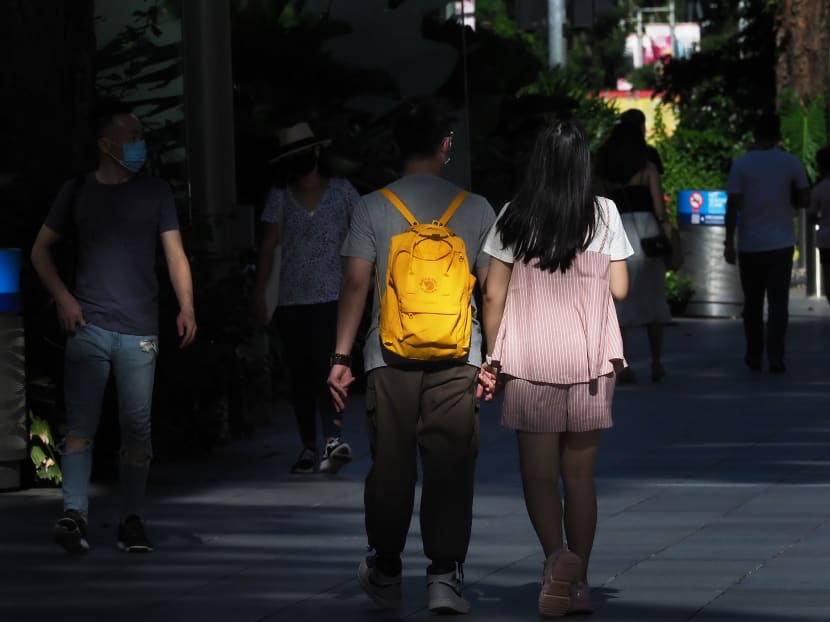
A survey conducted by the National Population and Talent Division (NPTD) from July to August last year found that more than half of single respondents went on dates at least once a week.
More than 800 people, with over half of them being singles, responded to the survey which looked at attitudes towards dating in Singapore.
Despite having more opportunities to meet people, the age at which Singaporeans are getting hitched continues to rise, based on latest statistics which were released earlier this week.
In 2019, the median age of first-time grooms was 30.4, up from 30.2 in 2018. For first-time brides, the median age was 28.8, up from 28.5 in 2018.
A decade ago, in 2009, the median ages of first-time grooms and first-time brides were 29.8 and 27.5, respectively.
Singles aged between 20 and 35 interviewed by TODAY said they were dating actively and going on dates as frequently as once every two weeks. However, these dates usually fell short of their expectations and did not progress to any long-term relationship.
Has the luxury of choice led to even higher expectations when looking for a life partner? The reality is more complicated.
Ms Darshini, a 30-year-old manager in the tourism and heritage industry, said that she had gone on a string of dates with three different men within two months in early 2018. However, due to a lack of chemistry, none of them progressed beyond the first date.
Chemistry aside, one common lament among the single Singaporeans interviewed is a lack of time to date, with work and social commitments making it difficult for them to invest their time and energy into a romantic relationship.
And when they do give romance a chance, the fact that they are constantly pressed for time means that the process has to be efficient, with a lot hinging on the first date. If there is no “chemistry” during the first physical meeting, it is on to the next person.
DATING UNDETERRED BY COVID-19
Few couples had expected the Covid-19 virus, which first surfaced in Singapore in January, to disrupt their dating lives. But disrupt it did, as the authorities introduced measures such as social distancing to curb community spread.
Many singles have since adapted themselves to the new normal by finding ways to keep the spark alive despite not being able to meet physically.
Mr Donovan Foong, 22, for instance, had only managed to squeeze in three dates with a girl he had gotten to know through Coffee Meets Bagel in March, before the circuit breaker kicked in.
With strict rules in place to prevent those who are not related from meeting, he had to find ways to keep the momentum going with her virtually.
On top of texting and video-calling every other day, he would try to mimic physical dates by sending a bottle of gin to her house so that they could have drinks together over video call. His efforts paid off.
“There was a huge sense of happiness to see each other at our first meeting after the circuit breaker. I felt I was talking to the same person,” said the full-time national serviceman.
For others, having to date virtually for a prolonged period helped to strengthen mutual trust and understanding.
Ms Sandra Ong, a 24-year-old urban planner, had started a relationship last November. But her dating life lasted until early December when her boyfriend, who is a final-year student at NTU, had to leave for the United States on a student exchange programme.
Even when he returned in March, they were unable to meet face-to-face.
Still, dating through video calls had its own benefits, said Ms Ong, 24.
“It’s an advantage because you get to see each other in the home setting... For example, we see each other when we are not fully dressed up, so there is less pretence involved.”
The couple was also forced to find common topics to chat about to keep the conversation going, which helped them to learn more about each other.
When they finally met in June after the circuit breaker was lifted, Ms Ong said that she had a deeper understanding of her boyfriend.
‘IT’S ALL ABOUT CHEMISTRY’
Mr Aqil and his partner enjoyed their first date enough to plan for a second meeting. Even then, he is not sure if there is chemistry and that they are still “feeling things out”.
While he is prepared to give it another go, many other singles interviewed cited chemistry as a necessary condition before deciding to go beyond the first date.
“Chemistry” refers to a sense of commonality and familiarity which encourages people to develop their relationship further, said Professor Paulin Tay Straughan, a sociologist at the Singapore Management University (SMU).
She noted that “chemistry” largely depends on what one is attracted to in a partner, such as physical looks or the ability to confide in each other.
Biological anthropologist and chief scientific adviser to online dating website Match.com Helen Fisher — who wrote the 2004 book Why we love: The Nature and Chemistry of Romantic Love — noted that the romantic “chemistry” is caused by chemicals generated in the brain which create a sense of attraction to another.
The singles interviewed used more intangible terms to describe “chemistry”, with most pointing to good conversation as the foundation of a good first date.
Mr Matthew Lim, a 31-year-old communications executive, said: “Generally, if the other person is easygoing and someone I can banter with, I wouldn’t mind spending time with her.”
Several others added that they would consider progressing from a first to second date if the other party had an interesting personality or seemed to have compatible views, among other things.
Some dating experts have a more rudimentary explanation: It all boils down to looks and physical attraction.

Ms Violet Lim, the co-founder of dating agency Lunch Actually, said that her agency can provide up to 70 per cent mutual matching in terms of what its clients are looking for in prospective dates.
But it cannot guarantee there would be “chemistry” on a first date since “it is about whether there is enough physical attraction to ask the other person out for a second date”, she said.
Ms Shn Juay, the chief executive officer of Paktor Group, likened chemistry to “love at first sight”.
However, she stressed that sustaining a relationship boiled down to compatibility, and Paktor Group’s dating agency GaiGai has matched people based on diverse aspects such as their views on finance, future and family.
She added that it is complementary values, rather than similar hobbies and lifestyles, that keep couples together for the long haul.
Prof Straughan noted that the rise of online dating has resulted in singles placing more emphasis on looks. If the date’s physical appearance does not meet expectations within the first few minutes of interaction, it becomes difficult to establish a sense of familiarity or connection with the person.
But Prof Straughan pointed out that it takes time to build chemistry, with people growing more comfortable with each other over time.
However, some singles beg to differ. To them, it is important to hit it off from the start for them to commit long-term to someone.
Pointing to her past dating experiences, Ms Darshini said: “I know it’s not impossible (to find someone I have chemistry with).... it’s just that I need to try harder.”
EAGER TO GET MARRIED BUT WAITING FOR ‘THE ONE’
The growing popularity of dating apps and the ease with which singles can set up dates have given rise to a trend of people going through multiple first dates in a short span of time, said dating experts.
“In the past, when people go on dates, it is exciting and they need to prepare for it. But now, it’s not that difficult to get a first date,” said Ms Lim from Lunch Actually.
With dates easier to come by, there is also less of an urgency to choose a partner, she added.
The knock-on effect is that Singaporeans are getting hitched later.
According to the Singapore Department of Statistics, fewer people had also gotten married last year. There were 25,434 marriages in 2019, about a 6 per cent drop from the year before.
While Singaporeans are marrying later and fewer are getting married, it appears that by and large, singles are still keen to settle down eventually.
A study released by the Institute of Policy Studies in 2013 found that among 2,000 Singapore citizens and permanent residents aged between 21 and 39 who had never married, a large group — about 70 per cent — still desired marriage and parenthood.
The survey found that a higher proportion of males (72.3 per cent) indicated that they definitely wanted to get married, compared to females (65.1 per cent).
More recent surveys reflected the same desire among young singles to get married. The survey by NPTD, for instance, found that most of its 800 respondents started to seriously think about finding a life partner from the ages of 22 to 25.
In a sign of more singles going online to find love, a report by mobile analytics platform App Annie found that users in Singapore spent a total of S$9.9 million on dating apps last year — an 80 per cent spike compared with 2017. The two most popular apps are Tinder and Coffee Meets Bagel.
Dating agencies are also seeing more business, amid reduced stigma in using their services.
Lunch Actually said it had seen a 44 per cent increase in new sign-ups in June compared with the same period last year while GaiGai, the dating agency under Paktor Group, said that it registered an 18 per cent year-on-year increase in its membership.
Young singles told TODAY that they are keen on getting married, with most saying that they are motivated to date seriously after watching their peers tie the knot. For some, however, looking for a life partner would have to wait until they achieve job and financial stability.
Mr Wong, for instance, said he is keen to get married within the next four years, partly because he wants to have children when he is younger so that he will have the energy to raise them. However, he has yet to meet “someone to share the joys of life with”.
Mr Siva Chandramohan said he had initially wanted to get married at his current age of 28.
However, the executive at a statutory board has since revised his “ideal age” to get married to 33, partly due to the need to achieve stability in his new job.
“I’m looking for someone who is understanding, patient, tolerant, compassionate, decisive and easygoing. But I feel like most people I meet fall short, especially when it comes to having understanding, patience and tolerance,” said Mr Siva, who uses dating apps such as Tinder and Bumble.
If Singaporeans are dating more with the aim of getting married, why are they still taking so long to settle down and start a family?
Experts had previously attributed this delay to the fact that singles simply have too many options available to meet people, making it harder to decide who they want to spend the rest of their lives with.
SMU’s Associate Professor of Psychology Norman Li, whose research interests include mate preferences and mate value, said that when it comes to a decision as major as deciding who to be with during one’s lifetime, a person must feel that he or she is making the best choice.
“Imagine going to a mall with hundreds of nice restaurants, each with a menu of hundreds of palatable food choices. It would surely take a lot longer to decide what to eat than if there were only a few restaurants each with only a few food choices,” he said.
Prof Straughan said that her preliminary research on the use of dating apps in Singapore has found that while such apps have low barriers in helping singles expand their social circle, this has resulted in them giving potential relationships little chance to develop.
“There seems to be a reluctance among singles to go on a second date or give the relationship a chance to develop. It seems easier to go back to the app and swipe again,” she said.
This is different for dates set up by friends or family, said Prof Straughan. If such dates do not go well, friends and family are likely to encourage the person to give the other party another chance, increasing the likelihood of a second date.
The emphasis on looks via the use of dating apps also means that singles are searching for their partners based on superficial criteria rather than compatibility, she noted.
However, some singles like Ms Darshini, who uses Tinder and Coffee Meets Bagel, disagree.
Despite having more options, Ms Darshini said she invests time — it can take several weeks — and energy into setting up a date.
“Having an option of going back to the app after a date is not really consoling because it took so long to get a date,” said Ms Darshini.
‘TOO TIRED TO DATE’
While a date is now just a swipe away, some singles said they are nevertheless simply too tired to date, with work and time with family and friends taking up most of their waking hours.
A public servant who wanted to be known only as Ms Rachel said that having just started a new job last October, she channels most of her energy into improving her competency at work.
“I’m too stressed with work, and I don’t have time to think about anything else, especially investing in a new relationship...I just look forward to sleeping in on the weekends,” said the 24-year-old, who has not been on a date since leaving university last year.
Several singles have also pressed the pause button in between several months of dating, as they find it emotionally draining.
Mr Wong, who has been on Tinder since 2017, said that he usually takes a four-week break after several months of active dating as he needs time to “recharge (his) social energy”.
For several others, like Mr Siva, a break is also necessary to recover from the disappointment of not meeting anyone suitable.
“I am not having much success in the dating world. And it is quite tiring to be putting myself out there every time, hoping someone likes you back,” Mr Siva said.
Prof Straughan said it is unsurprising that young singles in Singapore feel they are too busy to date, given the culture of long working hours.
And with singles living with their families, there is also little of that sense of loneliness that will typically drive them to seek out a significant other for companionship.
As a result, looking for a life partner tends to take second place among their other priorities, she added.
ISSUE OF EXPECTATIONS
So what do singles here look for in their prospective partners?
Those interviewed cited qualities such as sincerity, honesty, as well as lifestyle and personal values.
Ms Juay of Paktor Group said that having such aligned personal values will help couples remain in long-term, committed relationships.
Prof Straughan said that with women becoming more financially independent, traditional checklists, such as the income level or family background to decide if a couple is compatible, are no longer relevant now.
Women especially are looking for partners who could add to their quality of life, but the flipside is that this could make it more difficult for them to find someone whom they can be with for a lifetime.
What some young singles do not realise is that beyond first dates, they need to give their prospective dates time to show their qualities, Prof Straughan pointed out.
However, some singles such as Ms Darshini disagreed. They believe that such qualities can be teased out within the first date or two, for instance by asking pointed questions, such as their views on sexism.
Still, some singles concede that they could be seen by the older generation as being too picky.
Social worker Ms Ruby, for instance, said that she expects her future partner to not only have a university degree but also to be ambitious and have a personality that matches hers.
“My mother has low expectations. For her, my partner must be of the same religion as me, a university degree holder and of the same race. She does not care about personality,” said the 26-year-old who declined to give her full name.
.embed-container { position: relative; padding-bottom: 56.25%; height: 0; overflow: hidden; max-width: 100%; } .embed-container iframe, .embed-container object, .embed-container embed { position: absolute; top: 0; left: 0; width: 100%; height: 100%; }LEAVING LOVE TO FATE
Even as young Singaporeans actively date in the hopes of settling down, there remains a small group of singles who have never dated, or are not actively dating.
This group includes those who believe that love should be found “organically”.
Ms Nur Syafiqah Mahazir, a 25-year-old student at Murdoch University, for one, prefers getting to know people as friends first before taking the relationship to the next level.
Ms Pooja, a 31-year-old civil servant, has never dated before and said she does not intend to.
Instead, she believes that she should meet her soulmate “through fate”, in ordinary settings such as at her workplace.
But Ms Pooja’s friend, 33-year-old Ms Surya, disagrees with her approach, calling it “too dreamy and unrealistic”.
“Ladies who actively date are (still) unable to settle down despite using countless dating platforms. To meet someone naturally like in the movies, it just does not happen in real life,” said Ms Surya, an IT consultant. Both women wanted to be known only by their first names.
Dating experts said that such “fatalistic” views of love do little to help bring singles closer to finding their potential partners.
Ms Lim of Lunch Actually pointed out that dating is essentially a “numbers game”, where one has to maximise the number of people he or she meets to secure dates.
It is important to have dating experiences or share such experiences with friends so that one could get a realistic sense of how romantic relationships develop in real life, she said.
Those with no dating experience also need to be clear that they must take action to meet their potential partners, such as joining dating apps to meet people.
For singles who do not believe in dating at all, Ms Lim said it is up to their friends and family to create opportunities for them to meet new people, such as inviting the former to events or parties where they have the opportunity to widen their social circles.
KEEPING FAITH
Amid bad dates, lack of time and “being picky”, young singles interviewed remained optimistic that love is just around the corner for them.
While some admitted that they are frustrated at the lack of results despite years of dating actively, their more positive dating experiences have nevertheless given them hope that they will eventually find someone.
Ms Surya, who has been trying to meet people through dating apps, friends and family for the past six years, said it is disappointing not to have met the right person yet.
Nevertheless, her failed dating experiences have helped to shape her views on the type of partner she wants.
“Everything happens for a reason and every guy I met made me think about what I really want in a guy,” she said.
This article is written in collaboration with Hello Love.
Related topics
chemistry Coffee Meets Bagel family and relationships parenting dating marriageStay in the know. Anytime. Anywhere.

Subscribe to our newsletter for the top features, insights and must reads delivered straight to your inbox.
By clicking subscribe, I agree for my personal data to be used to send me TODAY newsletters, promotional offers and for research and analysis.






