
Higher starting pay, more development opportunities for special education teachers
SINGAPORE — The starting salaries for special education (Sped) classroom teachers and teacher aides will be raised from this year, and more opportunities for professional development will also be extended to them, Second Minister for Education Maliki Osman said in Parliament.
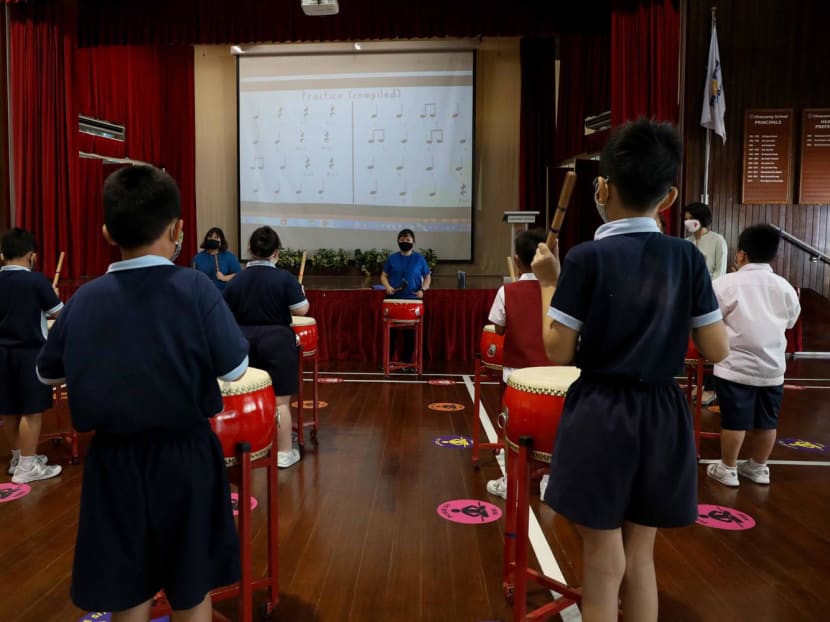
Students from APSN Chaoyang School playing the drum in the school hall on Nov 5, 2020.


This audio is AI-generated.
- The starting salaries for Sped classroom teachers and teacher aides will be raised from 2024
- More opportunities for professional development will also be extended to them
- The exact salary enhancements will vary depending on their experience, competencies, job role and work performance
- In addition, monthly fees in nine higher-fee Sped schools will be lowered by mid-2025


SINGAPORE — The starting salaries for special education (Sped) classroom teachers and teacher aides will be raised from this year, and more opportunities for professional development will also be extended to them, Second Minister for Education Maliki Osman said in Parliament.
These will be done to “enhance the attractiveness” of the Sped teaching profession and to strengthen Sped teachers’ capabilities, Dr Maliki said on Monday (March 4) during a debate on the spending plans of the Ministry of Education (MOE).
While the exact salary enhancements will vary depending on their experience, competencies, job role and work performance, Sped classroom teachers and teacher aides can expect the following changes:
Sped classroom teachers
- From 2024: Starting salaries will be increased by up to 15 per cent. Teachers may receive a starting salary of up to S$3,600 a month before they undergo their Diploma in Special Education training
- Between 2024 and 2026: Teachers may receive salary increases of up to 12 per cent
- By 2026: Teachers can expect to receive monthly salaries ranging from S$3,000 to more than S$7,000
Teacher aides
- From 2024: Starting salaries will be increased by up to 17 per cent. Aides may receive a starting salary of up to S$2,100 a month
- Between 2024 and 2026: Aides can receive a salary increase of up to 15 per cent
- By 2026: Aides can expect to receive monthly salaries ranging from S$2,000 to more than S$4,000
In a separate factsheet shared with the media, MOE said that untrained classroom teachers in Sped schools are required to first experience a teaching stint at their Sped school to assess their suitability for the mandatory Diploma in Special Education (DISE) programme conducted by the National Institute of Education.
Teacher aides are not required to attend the DISE programme, MOE said, adding that Sped schools are recommended to increase classroom teachers’ salaries upon completion of the diploma course to “recognise their upgraded skills and qualification”.
As of December 2023, there were close to 1,700 teachers across the 25 Sped schools. More than half of them have a degree, the ministry disclosed.
“With more Sped schools being set up in recent years, the number of teachers hired over time has also increased,” it said.
To meet the needs ahead, the Sped sector will have to further increase its teaching fraternity by around 350 teachers by 2030.
To strengthen Sped teachers’ capabilities, the ministry will also introduce more professional development programmes to develop expertise in supporting different disability profiles.
“We appreciate our Sped educators and remain committed to supporting them,” Dr Maliki said, adding that a school staff developer will be appointed in each Sped school to “enable professional growth”.
In a separate infosheet distributed by MOE to the media, the ministry said it will also extend MOE’s Teacher Leaders Programme to Sped teacher-leaders to equip them with skills to innovate in the classroom and act as mentors for their less experienced colleagues.
Vice-principals in special education schools will also receive training in mentoring and coaching for leadership development, MOE said, adding that such opportunities can foster the exchange of ideas and knowledge between educators in Sped and mainstream schools.
In his Budget 2024 statement on Feb 16, Deputy Prime Minister Lawrence Wong said that the maximum monthly fees chargeable for Singaporean students at special education schools would be reduced from S$150 to S$90, in a bid to alleviate cost pressures for families of children with special needs or disabilities.
With this change, nine higher-fee Sped schools are expected to have their fees reduced by up to 60 per cent for Singapore citizens, Dr Maliki said.
MOE will work closely with social service agencies to lower the monthly fees in these nine Sped schools serving students with autism spectrum disorder and multiple disabilities.
The nine schools are:
- AWWA School @ Napiri
- Eden School
- Eden School (Campus 2)
- Pathlight School
- Rainbow Centre (Margaret Drive)
- Rainbow Centre (Yishun Park)
- Rainbow Centre (Admiral Hill)
- St Andrew’s Autism School
- St Andrew’s Mission School
More than 3,500 students and their families stand to benefit from these changes, which will take effect by mid-2025.
The fees will be determined by the schools and will be communicated to parents when ready, MOE said.
Dr Maliki said: “We want to continue enabling students with special educational needs to fulfil their potential, by supporting them in appropriate educational settings that bring out their best.”
Related topics
special education special education schools Maliki Osman MOEStay in the know. Anytime. Anywhere.

Subscribe to our newsletter for the top features, insights and must reads delivered straight to your inbox.
By clicking subscribe, I agree for my personal data to be used to send me TODAY newsletters, promotional offers and for research and analysis.





