
'Tiny houses' on Lazarus Island: Close to nature but can be damaging to ecosystem if not managed well, nature groups say
SINGAPORE — Allowing visitors to spend the night on Lazarus Island in eco-friendly “tiny houses” may be a good way to get people closer to nature, but it may also have a detrimental impact on the ecosystem if it is not managed well, nature groups warned.
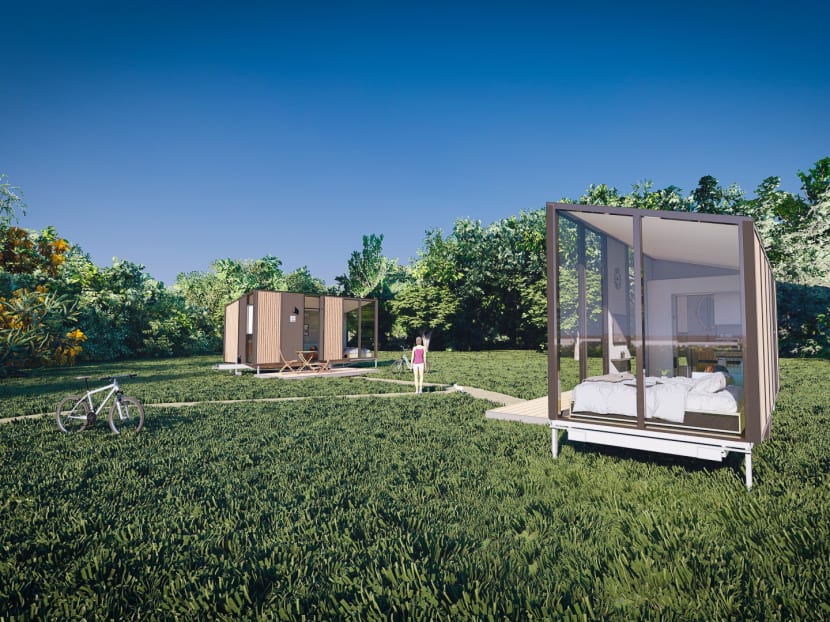
An artist's impression of the Tiny Away Escape@Lazarus Island accommodation.

- Some environmental groups said having places for visitors to stay overnight on Lazarus Island may be a good way to get people to appreciate nature
- However, they are also concerned that if not managed properly, the plans to have short-term accommodations on Lazarus Island may adversely affect the ecosystem
- Public education will be needed to warn visitors about the dangers of staying on the island, such as encounters with venomous sea creatures and the strong sea currents


SINGAPORE — Allowing visitors to spend the night on Lazarus Island in eco-friendly “tiny houses” may be a good way to get people closer to nature, but it may also have a detrimental impact on the ecosystem if it is not managed well, nature groups warned.
Their comments on Wednesday (March 1) came a day after an announcement in Parliament that five of these accommodation cabins will be made available on Singapore’s southern island from April.
The cabins, called Tiny Away Escape@Lazarus Island, are provided by Big Tiny company, which also operates in countries such as Australia, Malaysia and New Zealand.
Plans do not end after the set-up of the tiny houses, which are between 150 and 170 sqf in size, Sentosa Development Corporation said earlier.
The corporation is collaborating with the Ministry of Trade and Industry on this venture and said that other amenities and attractions such as a convenience store, overnight glamping experiences and non-motorised water activities on the island will be launched in phases from around June this year.
There is already a ferry service on selected days from Sentosa Jetty@Cove that takes visitors to Lazarus Island.
Dr Shawn Lum, president of the Nature Society (Singapore), said that at face value, having the cabins on the island could be a good opportunity to establish a standard here for meaningful visitor experiences that not only promotes a small ecological footprint but celebrates nature.
He added that it is good to have an accessible island in Singapore that is as close to an original, pre-settlement state as possible, and to allow people to imagine how the entire Singapore-Johor-Riau area might once have looked with natural vegetation and undisturbed marine life.
“Of course, we can go to Indonesia to find thousands of uninhabited islands, but it would be amazing to have such a place in our tiny island home of more than five million inhabitants.”
Mr Stephen Beng, the chairperson of the Friends of the Marine Park ground-led initiative, said that the Covid-19 pandemic and the earlier strict border controls showed that people do need things to do in land-scarce Singapore.
"We have to give people things they like to do, and things to do, but the question is how we can sustainably and responsibly do it," he added.
Dr Lum said that how this goal can be achieved will ultimately be the result of planning, management and programming.
HOW WASTE, HUMAN ACTIVITIES, PESTICIDES CAN SPOIL NATURE
A concern raised by the environmental groups who spoke to TODAY was that of waste management.
Ms Sam Shu Qin, a co-founder of the non–profit organisation Our Singapore Reefs, worries that if not managed properly, trash from visitors will likely attract families of the resident macaque (a species of monkeys) and potentially lead to the kind of human-wildlife conflict already seen on the mainland.
Beyond that, there are also concerns that trash may enter the waters around Lazarus Island and affect marine biodiversity, Ms Sam said. Her organisation is involved in clearing up marine litter around Singapore’s southern islands.
Heavy objects, such as glass bottles, that land in the water could end up damaging corals, she added.
And even if that were not the case, the planned increase in human activity such as kayaking could lead to visitors unintentionally damaging the corals as well.
“Corals provide shelter and food for other marine life, and they take a long time to grow,” Ms Sam said, as she warned of the cascading effects a damaged reef system would have on other marine life.
Dr Lum also voiced concerns about vector management for pests and insects, stating that efforts must be made not to use toxic pesticides that could inadvertently waft across the forest and waters to poison both terrestrial and marine life.
The “tiny houses”, too, should be sited away from more sensitive sites such as those known for groundbird nesting.
WHAT DANGERS MAY LURK
Although a wide variety of creatures may be spotted during inter-tidal walks, efforts must also be made to ensure that visitors do not pick up any marine life that they see, Ms Sam said.
This will also prevent visitors from getting stung by poisonous animals such as urchins, jellyfish or the cone snail, she added.
Both Dr Lum and Ms Sam also spoke about the strong currents around Lazarus Island, which could be hazardous for anyone inexperienced with navigating them, particularly for swimmers.
WHAT IS BEING PLANNED AND WHAT SHOULD BE DONE
In response to TODAY’s queries, the accommodation operator Big Tiny said that there are trash bins within each of the cabins.
Its co-founder Jeff Yeo said: “On top of that, trash bags will be provided that guests can take along with them to bag their trash wherever they are and transfer them to the recycle bins on the island when convenient.”
He added that the company intends to organise bio-diversity tours with partners to educate guests on the flora and fauna present on Lazarus Island “so that they are more aware and will take steps to protect them”.
Errant guests found disturbing the wildlife there or despoiling the environment will be warned by staff members.
“Should they persist in doing what they do, we will not hesitate to report them to the relevant authorities and evict them from the island in the worst-case scenario,” Mr Yeo said.
In response to TODAY's queries, Sentosa Development Corporation said on Thursday that it has attained from the Singapore Land Authority (SLA) temporary occupation licences for five sites on the Southern Islands.
"We will be piloting small-scale, low-carbon footprint leisure experiences on Lazarus and Seringat Island with 'light-touch' activations," it said.
Seringat Island, also known as Pulau Seringat, is now part of an extended Lazarus Island.
These low-intensity offerings, the company said, will give visitors the opportunity to experience the rustic island environment in a sustainable and sensitive manner, while prioritising the conservation of ecologically sensitive areas.
"We will assess the type of offerings that resonate with visitors and will work closely with the operators on the five sites, to ensure that suitable measures are being undertaken during this pilot," it added.
The company has also consulted and "will continue to work with" government agencies including SLA and National Parks Board, as well as nature and heritage groups such as the Friends of Marine Park, to closely monitor and put in place suitable measures for guest safety and wildlife management, it said.
Commenting on the Government approving this initiative on Lazarus Island, Dr Lum believes that there is tremendous potential in the planned environment-friendly visitor plans.
However, to make it a success, it would need the input from a suite of experts from different fields ranging from heritage, marine conservation, waste management and even astronomy, he said.
“Engaging these experts while this venture is still in its early stages would be good.”
Mr Beng from Friends of the Marine Park said that any plans made would have to be backed by science and that it would also be useful to understand the carrying load for any activities that will be carried out on Lazarus Island.
"At the end of the day, conservation happens when people cherish a place. And the only way people will cherish a place is if they keep going there often,” he added.
Related topics
Lazarus Island environment tiny house tourismStay in the know. Anytime. Anywhere.

Subscribe to our newsletter for the top features, insights and must reads delivered straight to your inbox.
By clicking subscribe, I agree for my personal data to be used to send me TODAY newsletters, promotional offers and for research and analysis.






