
#trending: Tensions stew as Malaysians debate decision to gazette bak kut teh as heritage dish
MALAYSIA — A government decision to gazette bak kut teh as a national heritage dish of Malaysia has sparked fervent discussions among its lawmakers and citizens.
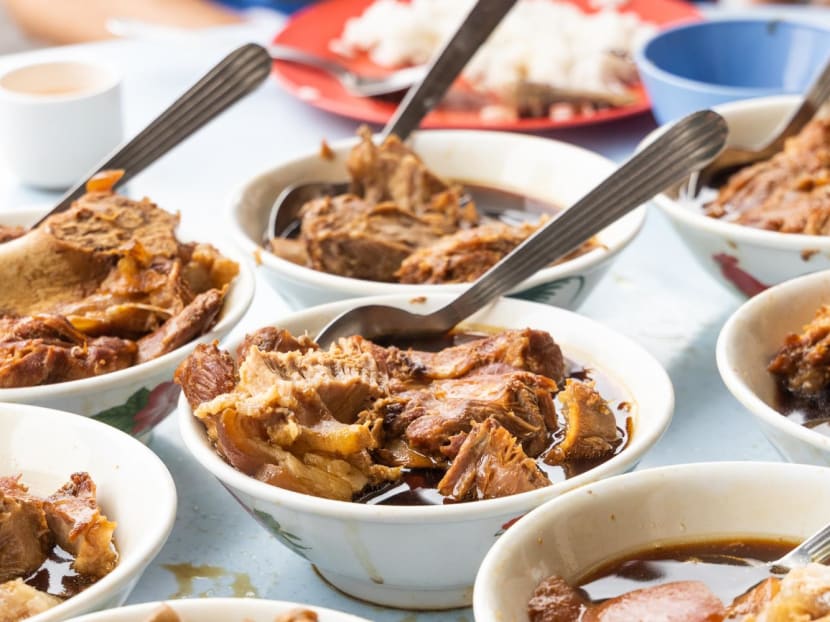
Bowls of bak kut teh, a pork bone soup made with aromatic herbs and spices.


This audio is AI-generated.
- A Malaysian heritage body's decision to designate bak kut teh as a national heritage dish has sparked a heated debate
- The popular pork-based soup was declared one of 10 heritage foods, alongside other traditional dishes and desserts
- Some people advocated for bak kut teh to be a cultural treasure, while others said the dish did not represent the country well
- The debate first erupted in June 2023 after a lawmaker proposed the move to prevent Singapore from “claiming” the dish


MALAYSIA — A government decision to gazette bak kut teh as a national heritage dish of Malaysia has sparked fervent discussions among its lawmakers and citizens.
The soup of aromatic herbs and spices made with pork bones was declared as one of 10 heritage foods in a government gazette last Saturday (Feb 24). Others in the list included noodles, snacks and traditional desserts.
While some people advocated for the official recognition of bak kut teh as a cultural treasure, others vehemently opposed the move, airing concerns about racial and religious sensitivities.
Apart from bak kut teh, the items in the list as reported by Malaysian media are:
- Burasak, a rice dumpling cooked with coconut milk and wrapped in banana leaf that is popular in Johor
- Kolo mee, a dry noodle dish from Sarawak
- Nasi ambeng, a Javanese dish of steamed white rice and assorted dishes that is popular in Johor and Selangor
- Dodol kukus tahi minyak, a Pahang-style steamed glutinous dessert
- Kuih lapis, a steamed glutinous "cake" with colourful layers that is said to have Indonesian origins
- Kuih karas, a crispy traditional snack believed to have originated from Kedah and Borneo
- Uthappam, a savoury South Indian crepe
- Jeruk tuhau, a pickled wild ginger from Sabah
- Air katira, a cold drink popular during the fasting month of Ramadan, made with katira gum, evaporated milk and fruit
‘ONLY EATEN BY SOME MALAYSIANS’
On Wednesday, opposition member of parliament Rosol Wahid called on the Ministry of Tourism, Arts and Culture to explain its decision to list bak kut teh as a national dish, The Star newspaper reported.
“People are concerned (to see) bak kut teh as part of our national heritage food,” the National Alliance party member said during a debate in parliament.
“If we (were) Taiwan or Hong Kong, it would not be an issue. We have national dishes like burasak and uthappam, which do not go against religion”.
About 60 per cent of Malaysia’s population follows the Islamic faith, which prohibits the consumption of pork.
“It would be better if the national heritage foods were dishes eaten by the majority of the country’s citizens.Opposition leader Razman Zakaria from the Malaysian Islamic Party (PAS)”
A day earlier, opposition leader Razman Zakaria from the Malaysian Islamic Party (PAS) posted on X (formerly Twitter) to also voice his dissatisfaction over the matter, suggesting that the dish does not truly represent Malaysia.
He wrote in Malay: “(It’s) very strange because bak kut teh is not eaten by all sections of (our) society. It is only eaten by some Malaysians.
“It would be better if the national heritage foods were dishes eaten by the majority of the country’s citizens.”
Dr Muhamad Akmal Saleh, chief of the youth wing of the United Malays National Organisation, echoed these disapproving sentiments, stating on Thursday: “It would be better to recognise other foods such as Chinese fried rice (or) many other foods that can be consumed by all citizens of this nation, regardless of race or religion.”
The assemblyman went on to say that Tourism, Arts, and Culture Minister Tiong King Sing should be sacked for failing to consider the sensitivities of Malaysians.
Dr Akmal’s Facebook post has received more than 1,500 likes and 630 comments as of Friday afternoon, with most of his followers endorsing his opinion.
Many citizens also took to online channels to denounce the move, claiming that bak kut teh was not part of the country’s culture.
A user on X wrote: "That's a controversial choice to say the least. It's not a national food choice to start with, since over half the population will not be able to consume this dish. Food for thought."
DIVERSITY THROUGH FOOD
Although the voices of dissent have been loud, many Malaysians online did not appear to have a problem with the inclusion of bak kut teh.
“Aren’t we all aware that we have more than one ethnic group in Malaysia? So shouldn't we allow each group to be represented properly and one of (the ways) is through food?X user "tyongjenmrk"”
Online users argued that a dish does not have to be halal or consumable by the Muslim-majority population to qualify as a heritage food. Some were perplexed as to why people were riled up over bak kut teh when kolo mee, another dish with pork, was also on the list.
They pointed out that other ethnic groups in the country deserve to be represented as well.
An X user wrote: “Why is it a problem to some people when bak kut teh is declared as a national food heritage? Aren’t we all aware that we have more than one ethnic group in Malaysia? So shouldn't we allow each group to be represented properly and one of (the ways) is through food?”
Another person questioned: “Are Malays the only ones residing in Malaysia? Why can’t we celebrate diversity on all fronts? Why do we have to be this narrow-minded?”
Yet another comment went: "I doubt more than half the population have eaten kolo mee or jeruk tuhau also. That's the point, national heritage food should be uniquely Malaysian, halal or not, consumed by all or not."
Someone suggested that if bak kut teh is not consumed by the majority, as long as it is unique to and originates from Malaysia, it can certainly be promoted as a product "for non-Muslim tourists”.
It is widely believed that bak kut teh was brought to Malaysia, specifically to the area of Klang, by early immigrants from China’s Fujian province.
The debate on whether the pork bone broth should be recognised as a Malaysian heritage dish first erupted in June last year after a lawmaker proposed doing so to prevent neighbouring countries from “claiming” the dish.
Mr Jimmy Puah, a member of parliament for Tebrau raised the issue in parliament after Singapore news channel CNA ran a documentary, which suggested that the popular dish may have originated from Singapore.
Related topics
Trending bak kut teh malaysian foodStay in the know. Anytime. Anywhere.

Subscribe to our newsletter for the top features, insights and must reads delivered straight to your inbox.
By clicking subscribe, I agree for my personal data to be used to send me TODAY newsletters, promotional offers and for research and analysis.





