
Parliament in brief: What you should know about S'porean bosses of S$500m firms, tattoos in schools, upcoming integrated HDB blocks
SINGAPORE — About 165 chief executive officers (CEOs) or managing directors (MDs) of companies with over S$500 million in shareholders’ equity are registered with the Accounting and Corporate Regulatory Authority (Acra) are Singapore citizens.
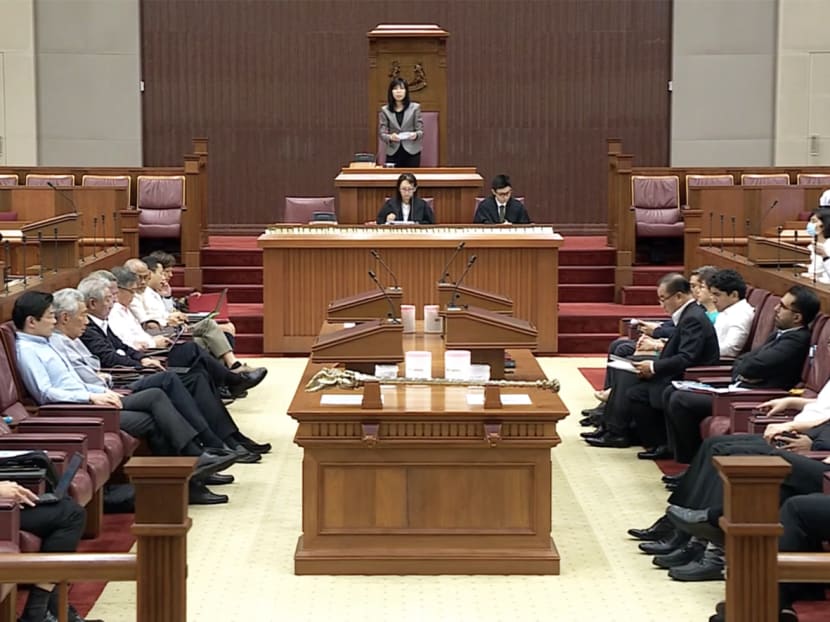
A photo of parliament in session on July 4, 2023.

- About 40 per cent of bosses of 413 firms with over S$500 million shareholders' equity and registered with Acra are Singapore citizens
- This figure was given by Deputy Prime Minister Lawrence Wong in response to a parliamentary question on Tuesday (July 4)
- Other topics discussed include the tattoo policy in schools and the projected numbers of integrated HDB blocks of flat with both sold and rental units


SINGAPORE — About 165 Singaporean chief executive officers (CEOs) or managing directors (MDs) of companies with over S$500 million in shareholders’ equity are registered with the Accounting and Corporate Regulatory Authority (Acra).
Deputy Prime Minister Lawrence Wong, who is also Finance Minister, gave this figure in a written response to a question from Progress Singapore Party's Non-Constituency Member of Parliament (MP) Leong Mun Wai on Tuesday (July 4).
Other topics, such as the tattoo policy in schools, and the Housing and Development Board's (HDB) projected number of upcoming integrated blocks of flats with both rental and sold units were also raised by MPs during the parliamentary sitting on Tuesday.
1. REGISTERED FIRMS WITH OVER S$500 MILLION IN SHAREHOLDERS’ EQUITY WITH S'POREAN BOSSES
Question by Mr Leong Mun Wai, Non-Constituency MP
- As of Dec 31, 2022, how many companies registered with Acra with more than S$500 million in shareholders’ equity have CEOs who are Singapore citizens?
Reply by Deputy Prime Minister and Finance Minister Lawrence Wong
In a written response to Mr Leong’s question, Mr Wong said that 413 companies with more than S$500 million in shareholders’ equity have filed CEO or MD information with Acra.
Among these companies, about 40 per cent, or 165, have CEOs or MDs who are Singapore citizens, he said.
The question has been in the spotlight because these are two of the criteria, among others, that need to be met by potential candidates for Singapore's Elected Presidency who are from the private sector.
On May 10, Education Minister Chan Chun Sing said that there are more than 1,200 companies with average shareholders’ equity at or exceeding S$500 million. He did not break down the figure further as Mr Wong did on Tuesday.
Mr Chan was responding to a parliamentary question posed by Mr Leong, who asked then for the estimated number of Singaporeans qualified to run for the presidency, broken down by those who fulfil public and private sector service requirements.
Mr Chan had said then that the Elections Department did not track the specific number of Singaporeans qualified to be elected as president.
Private sector candidates must have served for at least three years as CEO of a company with an average of S$500 million in shareholders' equity, among other criteria.
According to information available on Acra’s website, MDs and CEOs are optional positions but if a CEO is appointed, it is compulsory to file their personal particulars with Acra. This process is not required for the appointment of a MD.
2. TATTOO POLICY AMONG STUDENTS IN SCHOOLS
Questions by Mr Yip Hon Weng, MP for Yio Chu Kang Single Member Constituency
- How many students have been suspended from school for sporting tattoos in the past three years?
- What percentage of such students have participated in the tattoo removal programme by the National Skin Centre?
- What support or interventions have been provided for students who do not continue with the programme
- Whether the no-tattoo policy is consistently enforced across all schools
- How the Ministry of Education (MOE) is raising awareness of such a policy among students and parents.
Reply by Education Minister Chan Chun Sing
Mr Chan said that schools have clear rules which forbid students from sporting tattoos, while adding that schools rarely encounter students with tattoos.
If spotted, the offending student would be asked to cover up his or her tattoos, or have them removed, he added.
“In the past three years, fewer than 10 students per year were suspended for sporting tattoos and not complying with the school’s advice to cover or remove the tattoos," he said.
“Where necessary, schools have assisted in referring students for the tattoo removal programme by the National Skin Centre,” Mr Chan said.
He said that MOE does not track the number of students participating in the tattoo removal programme.
Schools engage students and parents on the school rules and expectations, including not having tattoos on any part of the body, he added.
Schools adopt an “educative approach” when managing students with tattoos, by providing them with guidance and counselling to help work through underlying issues.
3. PROJECTED NUMBER OF INTEGRATED HDB BLOCKS WITH RENTAL AND SOLD UNITS
Question by Mr Louis Ng, MP for Nee Soon Group Representation Constituency
- In each of the next five years, how many integrated blocks of flats with both rental and sold units does the Housing and Development Board (HDB) plan to build?
Reply by Minister for National Development Desmond Lee
Mr Lee outlined the number of such blocks currently under construction that will be completed in each of the next five years:
- Three blocks in 2024
- Two blocks in 2025
- One block in 2026
- Four blocks in 2027
- Five blocks in 2028
“We will continue building rental flats in integrated blocks where possible, including in Prime Location Public Housing projects, to ensure that our neighbourhoods remain inclusive,” Mr Lee said.
In January 2022, Mr Lee said at a forum that when the Government was deciding whether to include rental flats in new projects under the Prime Location Housing scheme, there were some who were against it.
But he believed that providing amenities and opportunities for people to share and use together can enable those of different socio-economic statuses to mix and intermingle.
"My belief is that will provide the kind of social discourse that we really need to foster proactively in a society where you might see social economic divide beginning to strain and pull apart (communities)," Mr Lee said then.
He was responding to a question on how to ensure mixing rental flats with sold flats would have the intended effect of uplifting those of a lower income and encouraging integration.
"This is an area which is always fraught with challenges," he said, adding that there are opposing views on mixing rental flats with sold flats.
Related topics
Parliament tattoo HDB flats elected presidencyStay in the know. Anytime. Anywhere.

Subscribe to our newsletter for the top features, insights and must reads delivered straight to your inbox.
By clicking subscribe, I agree for my personal data to be used to send me TODAY newsletters, promotional offers and for research and analysis.






