
PE 2023: Tharman taking his point on political affiliations and dependence on Govt 'too far', says Ng Kok Song
SINGAPORE — Presidential candidate Ng Kok Song on Tuesday (Aug 29) hit back at rival Tharman Shanmugaratnam over the hot topic of independence, saying that Mr Tharman might as well say no Singaporean is independent since all are "beholden to the Government" given that its policies affect everyone.

- Presidential candidate Ng Kok Song hit back at rival Tharman Shanmugaratnam over the thorny topic of independence
- He said Mr Tharman might as well say that no Singaporean is independent since all are “beholden to the Government” in that its policies affect everyone
- Mr Ng also repeated his pledge to sell his founding stake in wealth fund Avanda Investment Management in order to ensure his independence, if he is elected





SINGAPORE — Presidential candidate Ng Kok Song on Tuesday (Aug 29) hit back at rival Tharman Shanmugaratnam over the hot topic of independence, saying that Mr Tharman might as well say no Singaporean is independent since all are “beholden to the Government” given that its policies affect everyone.
Mr Ng, 75, also repeated his pledge to divest himself of his founding stake in wealth fund Avanda Investment Management, which reportedly had US$10 billion (S$14.6 billion) of assets under management as of February 2022, in order to ensure his independence, if he is elected President.
The day before, Mr Tharman sought to refute claims that as a former senior minister and member of the ruling People's Action Party (PAP), he is not sticking to the spirit of the Constitution, which precludes political party members from running to be President.
Mr Tharman quit politics and his PAP membership ahead of his tilt to become Singapore’s head of state.
During a forum on CNA on Monday, Mr Tharman had argued that it was “extremely simplistic” to judge whether a candidate is independent or not based on whether he has been a member of a political party.
“All our senior civil servants, all the senior people in the public (service) track… they owe their positions to bosses who are political figures. Are they obligated to their bosses because of that? Not necessarily. It depends on the individual,” he said.
He also cited the example of people who are from private companies, including construction and fund management firms, that are dependent on the Government but could be regarded as independent.
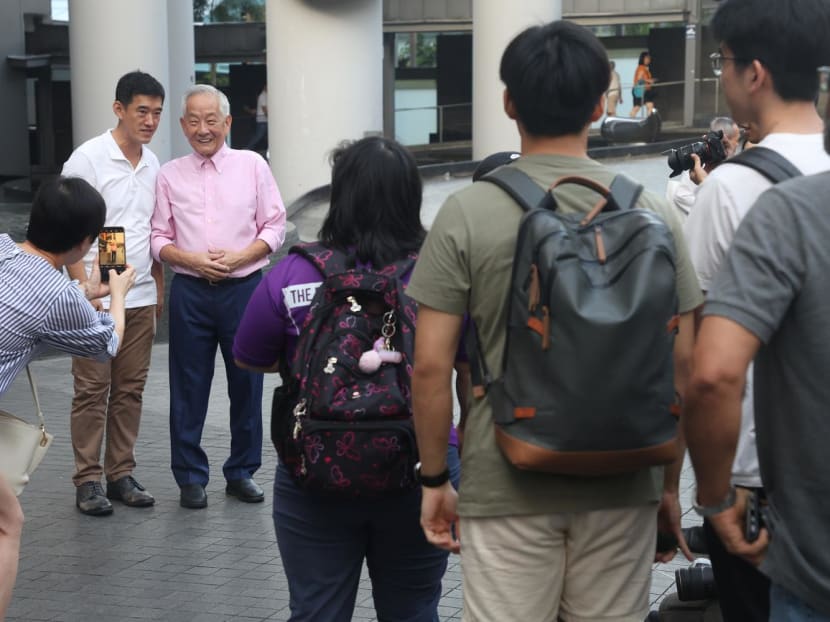
Speaking to the media on Tuesday morning during a visit to Marine Terrace estate, Mr Ng, a former top executive at sovereign wealth fund GIC, reiterated his argument that it is time for Singapore to “take the President out of politics” and that he is the only non-partisan candidate in the race.
“It’s not easy to find people who (are) competent, who (are) trustworthy and who (are) non-partisan,” he said.
“Because I’m competent, I will know what questions to ask. I will know how to be vigilant and I am non-partisan. I don’t owe any political party any favours. So I’ll be able to discharge my responsibilities without fear or favour.”
In a separate statement issued on Tuesday, Mr Ng responded: “First, Mr Tharman’s remark about the fund management company is clearly about me, and I would like to respond to that.”
Mr Ng said that “by comparing those with past political affiliations to anyone who is dependent on the Government in some way, I am afraid Mr Tharman is taking the point too far in arguing his case”.
“He might as well say all Singaporeans are beholden to the Government because all of us are impacted by government policies in one way or another. There is a big difference between being a senior government leader and the rest of us.”
Mr Ng also touched on two other key points in his statement: The President’s affiliation to a political party, and political cynicism and discourse among Singaporeans.
“For our elected presidency to be effective as a check and balance to Government, the elected President must derive his or her mandate directly from the people,” said Mr Ng, “This is clearly stated in our Constitution – the President must not be a member of any political party.”
He added that if the elected president were to take its mandate from or in opposition to political parties, then it would be a waste of time and resources to have a Presidential Election and a General Election separately, if they were both going to represent the latter.
Mr Ng referenced that this might be the reason why Singaporeans’ perception of how the ruling party controls all national institutions and key appointment holders may have left most cynical of local politics.
“Singaporeans feel PAP wants to have the final say in everything, and no matter what they say, PAP will decide and tell us what is best for us,” Mr Ng said.
“Our political discourse has now become pro-PAP and anti-PAP. The anti-PAP voices are getting more vocal. The pro-PAP camp is digging in. It is unhealthy and divisive.”
He added that Singaporeans must instead be “united”, and that he has spoken out against opposition figures “coalescing around Mr Tan Kin Lian” for the same reason.
“That is polluting the institution of our elected presidency,” Mr Ng said.
Still, Mr Ng stressed that he was not disputing Mr Tharman being a good minister but rather his comments that the elected presidency should be “about individuals”.
Mr Ng said that the Presidential Election ultimately “goes beyond the individual”, and should instead be about a system of governance that Singapore needs to safeguard its future.
The elected presidency is the check and balance on the Government, against profligacy or corruption, added Mr Ng.
“As Mr Tharman himself pointed out, the PAP has had its say on all our past elected Presidents. The time has come for us to take a step forward to reform the elected presidency.”
“Let us keep our elected presidency free from the influences and agendas of political parties so that the elected President can be effective and faithful in discharging our constitutional duties.”
Mr Ng said his pledge to sell his Avanda stake was a “worthwhile financial sacrifice”, to ensure that the office of the President remains independent and impartial.
Mr Ng is a co-founder of Avanda, along with two other men associated with GIC. The Business Times reported in February last year that Avanda's assets under management had more than doubled to US$10 billion since Mr Ng co-founded the firm in 2015, soon after leaving GIC.
For a person to divest himself of an asset usually means to sell the asset, but there are other possibilities that place the asset beyond the person’s ownership and yet do not involve its sale.
Related topics
Presidential Election 2023 Ng Kok SongStay in the know. Anytime. Anywhere.

Subscribe to our newsletter for the top features, insights and must reads delivered straight to your inbox.
By clicking subscribe, I agree for my personal data to be used to send me TODAY newsletters, promotional offers and for research and analysis.






