
Singapore to buy 8 F-35A fighter jets, adding to 12 F-35Bs it ordered earlier: Ng Eng Hen
SINGAPORE — The Ministry of Defence (Mindef) will buy eight F-35A fighter jets, and this will complement the 12 F-35B jets that it has already ordered, Minister for Defence Ng Eng Hen said.
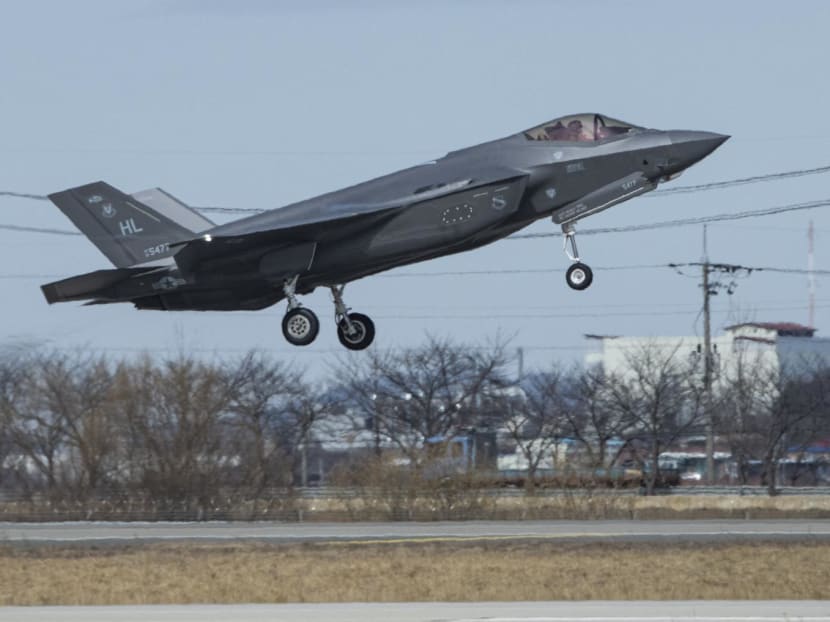
This handout photo taken and released on Feb 23, 2024 by the South Korean Defence Ministry shows a United States Air Force F-35A fighter jet taking off from the US Osan Air Base in Pyeongtaek during a South Korea-US joint air drill.


This audio is AI-generated.
- The F-35A is a variant of the F-35 that can travel further and carry a higher load of weapons than the F-35B variant
- The plan to buy the F-35As came just a year after Defence Minister Ng Eng Hen announced that eight more F-35Bs would be acquired
- In Parliament, he offered a pessimistic view of the geopolitical situation, pointing to the various conflicts around the world
- The first phase of Safti City will be opened in 2024, where soldiers can train in realistic operational environments, he added


SINGAPORE — The Ministry of Defence (Mindef) will buy eight F-35A fighter jets, and this will complement the 12 F-35B jets that it has already ordered, Minister for Defence Ng Eng Hen said.
The plans to buy the F-35A, a variant of the F-35 that can travel farther and carry a higher load of weapons than the F-35B variant, came just a year after he announced that Mindef would be acquiring eight more F-35Bs on top of four that it had ordered in 2020.
Dr Ng was speaking in Parliament on Wednesday (Feb 28) during a debate on his ministry’s budget, where he offered a pessimistic account of geopolitical developments.
“If you had asked me even five years ago, I would have said that the current generations... Gen X, millennials and Gen Z... would be just as lucky as the Merdeka Generation,” Dr Ng said.
However, developments such as Russia’s invasion of Ukraine, the Israel-Hamas conflict and the trade war between the United States and China have altered his assessment, he said.
“The risk of regional and even global conflict even in the next decade has become non-zero… I do not make this assessment lightly.”
He added that should Singapore be invaded, Mindef and the Singapore Armed Forces (SAF) “do not plan on the basis that we can depend on another country to come to our rescue”.
“If Singaporeans will not or cannot defend Singapore, there is no backstop, that is the simple truth. A strong SAF acts as a deterrence against aggression towards us and keeps adventurism at bay.”
To that end, it would be “too costly” not to put in the necessary spending on defence, Dr Ng said.
Mindef has therefore projected an expenditure in the coming financial year of around S$20.2 billion, a 2.5 per cent increase from the last financial year.
Compared with 2022, the increase is higher, but this is because the ministry is gradually resuming projects and activities disrupted by the Covid-19 pandemic, he explained.
WHY WERE F-35A AIRCRAFT PURCHASED?
Speaking to the media, Lieutenant Colonel (LTC) Zhang Jianwei said that the planned acquisition of the eight F-35A fighter jets is part of a “long-term strategic approach to build up our future fighter fleet”.
He is head of the next-generation fighter project office with the air plans department of the Republic of Singapore Air Force (RSAF).
The F-35As and the F-35Bs will “complement each other” to achieve an “optimal next-generation fleet” for RSAF, he added.
The F-35B has the capability to take off over a shorter distance than conventional fighter aircraft and can also perform vertical landings on areas smaller than a conventional runway.
“The F-35B's short take-off and vertical landing capabilities will reduce our runway dependencies and give us operational flexibility,” LTC Zhang said.
As for the F-35A, which conducts conventional take-offs and landings, it has greater endurance and the ability to carry payloads of greater capacities, which complements the F-35Bs.
Payload refers to weapons, ammunition, fuel tanks or other equipment that a fighter jet can carry during a mission.
“Operating both variants will therefore allow the RSAF to better meet our range of operational requirements.”
LTC Zhang also said that the acquisition of the F-35As will support the replacement programme for the ageing F16s, which will be drawn down from the mid-2030s.
The price at which Mindef had purchased the F-35As and F-35Bs was not disclosed. A 2023 article in defence technology magazine Breaking Defence put the cost of an F-35A at about US$82.5 million (around S$110 million) and an F-35B as US$109 million.
Dr Ng said on Wednesday that the F-35As are slated to be delivered around 2030. The eight F-35Bs ordered last year are expected to arrive in 2028, while the first four F-35Bs that were ordered in 2020 will be delivered by 2026.
WHAT ARE THE SIMILARITIES AND DIFFERENCES BETWEEN THE F-35A AND F-35B?
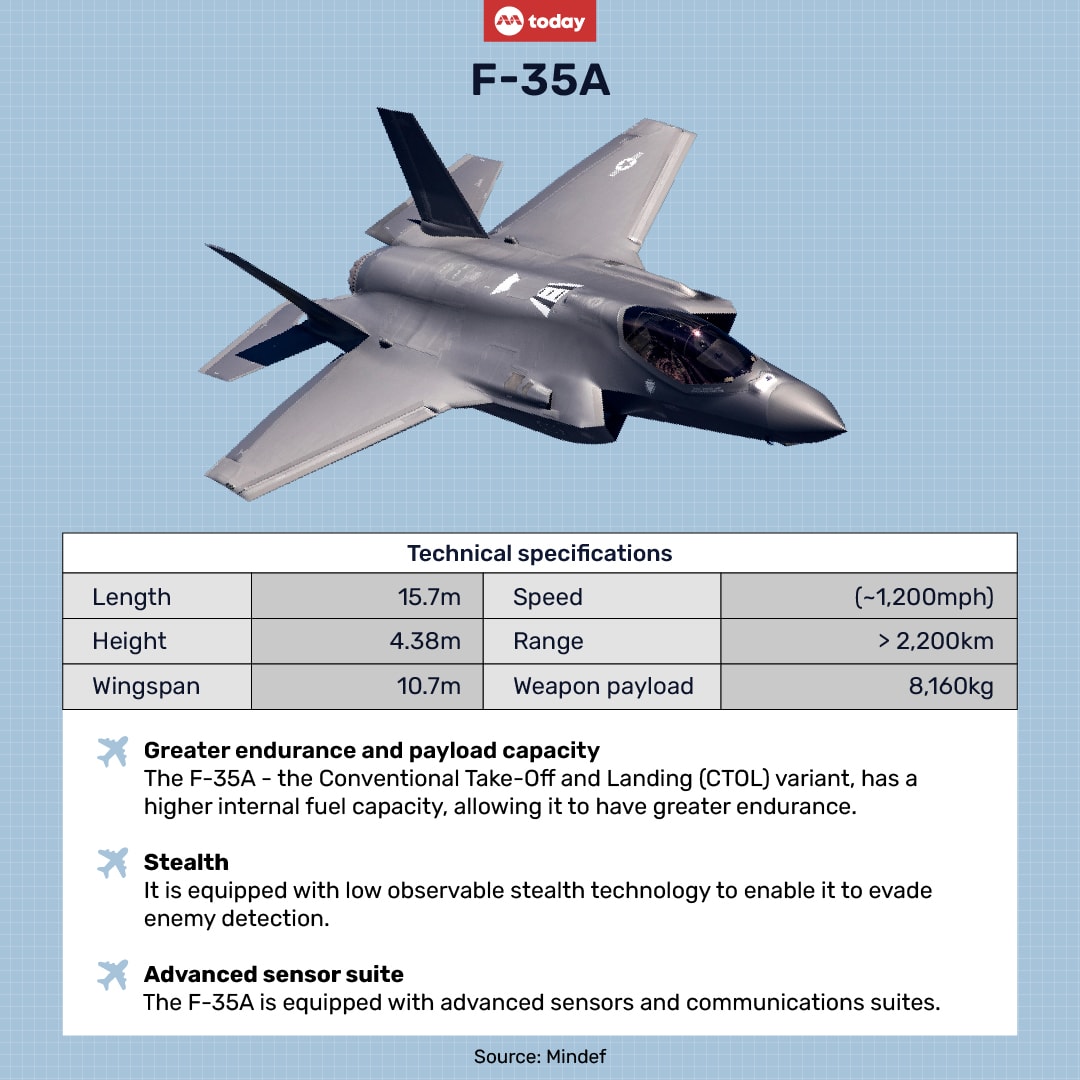
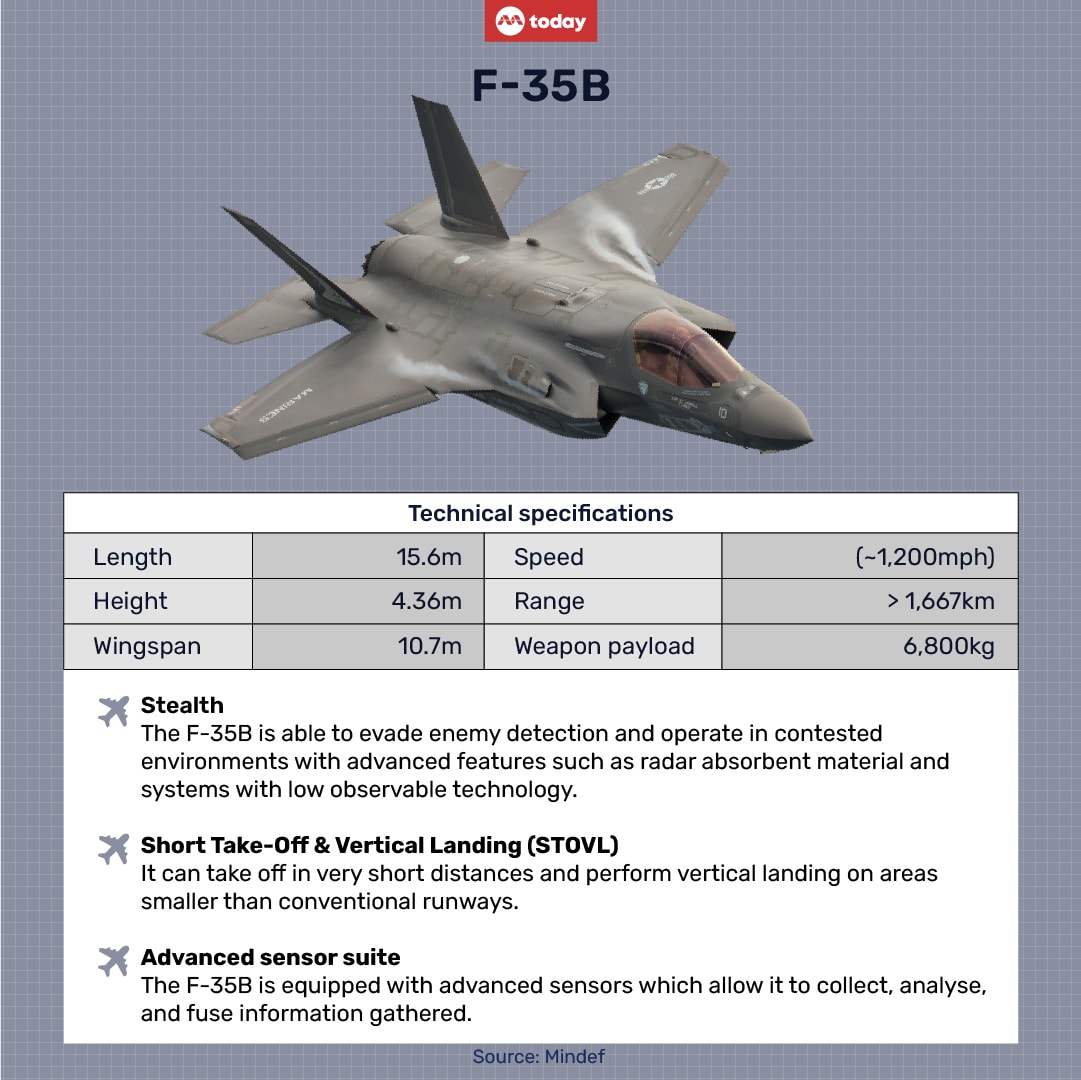
Here are some of the key differences and similarities between the F-35A and the F-35B:
- The F-35A has a greater endurance and payload capacity compared to the F-35B. It has a range of 2,200km, compared to the F-35B’s range of 1,667km
- The F-35A has a payload of 8,160kg, which is higher than the F-35B’s payload of 6,800kg. The higher payload is because the F-35A does not have a lift fan, which is present in the F-35B to provide for its short take-off and landing capabilities
- Both the F-35A and F-35B have stealth capabilities such as low observable stealth technology to enable them to evade enemy detection and operate undetected.
- Both have aligned edges, reduced engine signature, internal carriage of weapons and fuel, and embedded sensors that contribute to their stealth performance
- Both aircraft also have advanced sensors that can enhance their situational awareness and survivability
- The F-35A is 15.7m long and has a height of 4.38m — about the length and height of a double-decker bus — and a wingspan of 10.7m
- Similar to the F-35B, the F-35A can travel at about 1.6 times the speed of sound, or about 1,900km/h.
- The F-35As have a similar suite of weapons as the F-35Bs, including two types of air-to-air missiles, paveway laser guided bombs and small diameter bombs
NEW SAFTI CITY, MURAI URBAN BATTLE CIRCUIT
Dr Ng also gave an update on several training facilities.
One is Safti City, which will open progressively from this year.
The construction of Safti City was first announced in 2017, and will span an area the size of 100 football fields, with facilities to allow soldiers to train in realistic settings.
Mindef said in a statement that the first phase of the city will open this year, with a “realistic and challenging training environment”.
Features in the facility will include high-rise and interconnected buildings, a multi-storey car park, a bus interchange, an MRT station and “urban rubble” for disaster relief training.
The Murai Urban Battle Circuit (MUBC) is also set to open for training from April this year, Mindef said.
It is one of three “instrumented battle circuits” where soldiers can train. The other two circuits, located at Pasir Laba and Ama Keng in Lim Chu Kang, will be opened later this year.
The MUBC will be within the Murai Urban Training Facility and be equipped with “realistic battlefield effects”.
These include:
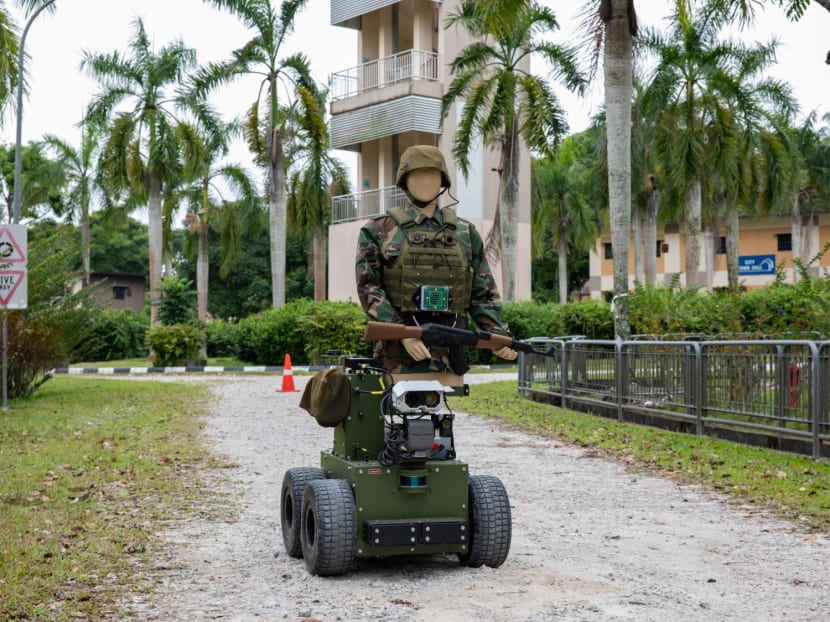
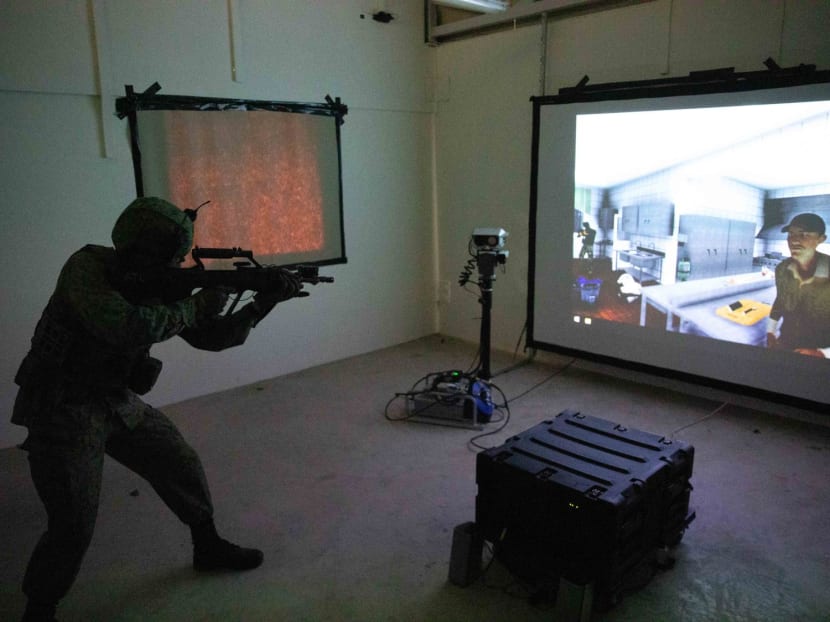
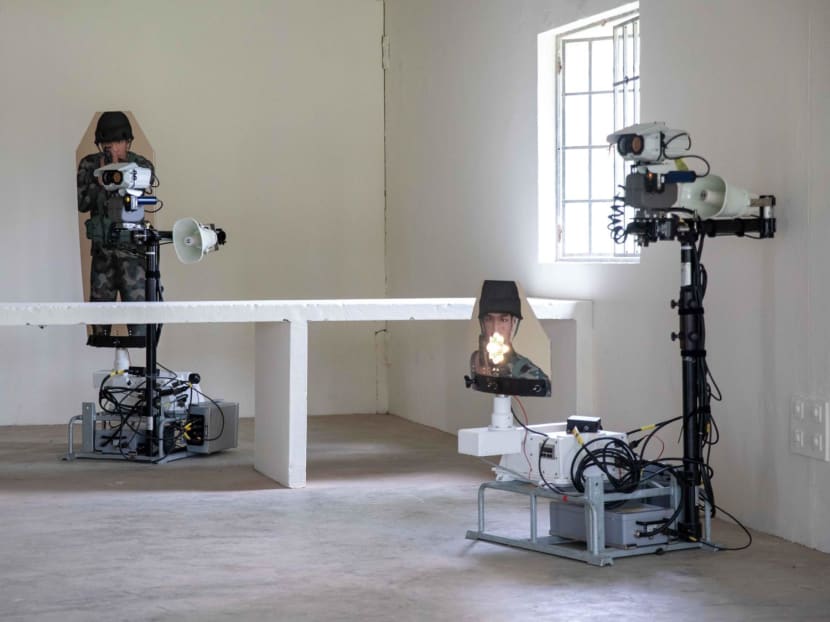
- Targets that can simulate “shooting back” at trainees, such as 2D and 3D mannequin targets, some of which can move about, and others that can “stand”, “sit”, “squat”, “kneel” and “prone” to simulate an enemy in different fighting postures
- A battlefield effect simulator that aims to simulate operational environments such as through smoke generators that produce smoke effects, a large blast simulator that mimic the sound and shockwave effects of detonating ammunitions or explosives, and a simulator that generates the sound and flash of weapons such as machine guns
- An exercise control system where training activities can be planned, monitored and controlled through a desktop or digital tablet, where targets and battlefield effects can be remotely controlled
Other purchases by Mindef include:
- The fourth and final Invincible-class submarine under the Republic of Singapore Navy (RSN) will be launched later this year in Kiel, Germany
- The first submarine was returned to Singapore last year and all four submarines will be operational in and around Singapore waters by 2028
- For the army, the next generation armoured track carriers, a military vehicle designed for transporting troops and equipment across rough terrain, will be brought into service
- The RSN’s unmanned surface vessel will go fully operational this year and patrol the Singapore Strait
- Designed and manufactured in Singapore, these unmanned surface vessels are fully autonomous and can safely navigate the nation's busy shipping lanes
In another announcement, Dr Ng said that the new Central Manpower Base opposite Cashew MRT Station in Upper Bukit Timah is on track to open in phases starting from 2025.
The current base, where National Service enlistees report for the pre-enlistment process, is located on Depot Road near Bukit Merah.
Related topics
Budget 2024 Mindef Ng Eng Hen RSAFStay in the know. Anytime. Anywhere.

Subscribe to our newsletter for the top features, insights and must reads delivered straight to your inbox.
By clicking subscribe, I agree for my personal data to be used to send me TODAY newsletters, promotional offers and for research and analysis.





